

As a seasoned supplier of oil - immersed transformers, I am often asked about the working principle of these essential electrical devices. In this blog, I'll delve deep into the science behind oil - immersed transformers, explaining how they operate and their significance in the power distribution network.
The Basics of Transformers
Before we get into the specifics of oil - immersed transformers, let's first understand the fundamental concept of a transformer. A transformer is an electrical device that transfers electrical energy between two or more circuits through electromagnetic induction. It consists of two or more coils of wire, known as windings, which are wound around a common magnetic core.
The primary winding is connected to the input voltage source, and the secondary winding is connected to the load. When an alternating current (AC) flows through the primary winding, it creates a changing magnetic field in the core. This changing magnetic field then induces an electromotive force (EMF) in the secondary winding according to Faraday's law of electromagnetic induction.
The ratio of the number of turns in the primary winding ($N_p$) to the number of turns in the secondary winding ($N_s$) determines the voltage transformation ratio of the transformer. The formula for the voltage ratio is given by:

$V_s/V_p = N_s/N_p$
where $V_p$ is the primary voltage, $V_s$ is the secondary voltage, $N_p$ is the number of turns in the primary winding, and $N_s$ is the number of turns in the secondary winding.
What is an Oil - Immersed Transformer?
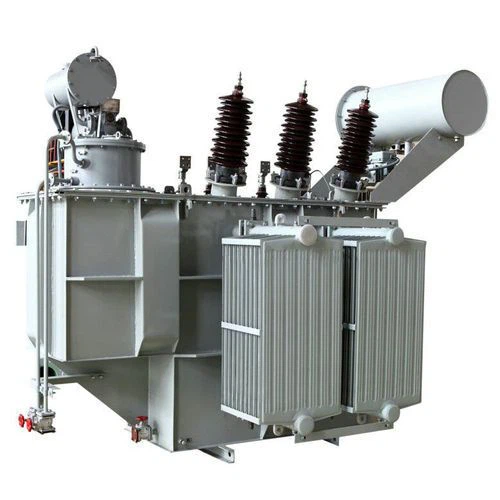
An oil - immersed transformer is a type of transformer where the core and windings are immersed in a tank filled with insulating oil. The oil serves several important functions:
- Insulation: The oil provides electrical insulation between the windings and the core, preventing electrical breakdown and short - circuits.
- Cooling: It helps to dissipate the heat generated by the transformer during operation. As the oil heats up, it rises to the top of the tank and is cooled as it circulates through external cooling fins or radiators.
- Arc Quenching: In the event of an internal fault, the oil can extinguish the arc that may occur, preventing damage to the transformer.
Working Principle of an Oil - Immersed Transformer
- Magnetic Circuit: The core of an oil - immersed transformer is typically made of high - grade silicon steel laminations. These laminations are stacked together to form a closed magnetic circuit. When an AC voltage is applied to the primary winding, an alternating magnetic flux is established in the core.
- Electromagnetic Induction: The alternating magnetic flux in the core induces an EMF in both the primary and secondary windings. According to Lenz's law, the induced EMF in the secondary winding opposes the change in the magnetic flux that produced it.
- Power Transfer: The power transferred from the primary to the secondary winding is given by the equation $P = VI$, where $P$ is the power, $V$ is the voltage, and $I$ is the current. Since power is conserved in an ideal transformer (neglecting losses), $P_p=P_s$, or $V_pI_p = V_sI_s$. From the voltage ratio formula, we can also calculate the current ratio as $I_s/I_p = N_p/N_s$.
- Cooling and Insulation: As mentioned earlier, the insulating oil plays a crucial role in cooling the transformer. The heat generated by the core and windings due to resistive losses is transferred to the oil. The hot oil rises to the top of the tank and is then cooled as it passes through the cooling system. This continuous circulation of oil helps to maintain the temperature of the transformer within safe limits.
Types of Oil - Immersed Transformers
- Distribution Transformers: These transformers are used to step down the high - voltage electricity from the transmission lines to a lower voltage suitable for residential and commercial use. They typically have ratings ranging from a few kilovolt - amperes (kVA) to several megavolt - amperes (MVA). You can find a wide range of distribution transformers, such as our 110KV 6.3MVA - 63MVA 3 - Phase Power transformer on our website.
- Power Transformers: Power transformers are used in power generation plants and substations to step up or step down the voltage for efficient transmission and distribution of electrical power. Our Power Transformers are designed to handle large amounts of power and are built to high - quality standards.
- Special - Purpose Transformers: There are also special - purpose oil - immersed transformers, such as furnace transformers, rectifier transformers, and traction transformers, which are designed for specific industrial applications. For example, our 25MVA 25000KVA 150KV Step Down Power Transformer With MR OLTC is suitable for certain industrial power - supply requirements.
Advantages of Oil - Immersed Transformers
- High Efficiency: Oil - immersed transformers have relatively high efficiency due to the low resistivity of the copper or aluminum windings and the effective cooling provided by the insulating oil.
- Long Service Life: With proper maintenance, oil - immersed transformers can have a service life of several decades.
- Good Insulation Performance: The insulating oil provides excellent electrical insulation, reducing the risk of electrical breakdown and ensuring reliable operation.
Maintenance of Oil - Immersed Transformers
Regular maintenance is essential to ensure the reliable operation of oil - immersed transformers. Some of the key maintenance tasks include:
- Oil Sampling and Testing: Periodic oil sampling and testing are carried out to check for the presence of contaminants, moisture, and dissolved gases. This helps to detect potential problems early and prevent major failures.
- Inspection of the Core and Windings: The core and windings should be inspected regularly for signs of damage, such as overheating, short - circuits, or insulation degradation.
- Cooling System Maintenance: The cooling system, including radiators and fans, should be cleaned and maintained to ensure proper heat dissipation.
Conclusion
Oil - immersed transformers are an integral part of the electrical power system. Their working principle is based on the fundamental laws of electromagnetic induction, and they play a crucial role in the efficient transmission and distribution of electrical power. As a supplier of oil - immersed transformers, we are committed to providing high - quality products that meet the diverse needs of our customers.
If you are in the market for oil - immersed transformers or have any questions about our products, we invite you to contact us for a detailed discussion. Our team of experts is ready to assist you in finding the right transformer solution for your specific requirements.
References
- Electric Machinery Fundamentals by Stephen J. Chapman
- Power System Analysis and Design by J. Duncan Glover, Mulukutla S. Sarma, and Thomas J. Overbye
- Transformer Engineering: Design, Technology, and Diagnostics by G. K. Dubey