You have seen them a thousand times during your road trips, marching across the hillsides and standing guard in the empty fields. These silent, steel giants that we often call electricity pylons are among the most visible but also the most overlooked structures in our surroundings. But their job is much bigger, and more interesting, than just keeping a bunch of wires up.
Imagine those transmission towers as the interstates for our electricity. They have one main job: to move huge amounts of power across really far distances, from where electricity is made at big power plants all the way to smaller networks that bring it to your house or office. Without such a backbone with high capacity, our modern world would not work.
It's important because it means they were designed on purpose, and it makes you wonder about things you've probably thought before. Engineers have a big problem: How do you get all that energy moving without losing most of it along the way? And this answer will explain why the towers are so tall, why the wires are so far apart, and what those glass things hanging off the sides of the towers are doing. By looking at the logic behind them, you will understand the invisible journey electricity takes every day. We will discover the secrets hidden within the familiar silhouettes as to why they have such particular forms and why birds may perch upon them securely. You won't just see a tower, you will see the spine of our electrical world.
What Is a Transmission Tower's Real Job?
You've seen them marching across fields and highways, but do you know what transmission towers are for? They're pretty basic: they just hold up the big, super-powerful electrical lines with their own special kind of clothes hanger. A tower by itself is not an electrical component; all it needs to do is be strong and tall enough to hold heavy, high-voltage wires up and out of reach of people, trees, and buildings on the ground. The real, invisible hero of this system is the air. By raising the power lines so high, the tower makes a huge, protective air cushion between the wire and the ground. Air is a great natural insulator which means it keeps electricity from jumping places where it doesn't belong. The tower's job is merely to keep that safe space of air. Without that carefully managed distance, the enormous power in those lines wouldn't have any trouble finding a dangerous shortcut to the earth.
Why Does Electricity Need a "High-Pressure" System for Long Journeys?
If the electricity is going to your wall socket, then why not send it there directly at that safe, low voltage from the power station? Think of it as trying to move water over a great distance. A normal garden hose with little pressure wouldn't work well because too much water would be lost along the way. To move a lot of water around efficiently, you'd want to use something with a lot of pressure, maybe even a pipe. Electricity is also similar, it needs some kind of "pressure" to go far without losing its strength.
And that electrical pressure is called voltage. Raising the electricity to a very high voltage allows power companies to send huge amounts of energy over hundreds of miles without losing much energy. And this is the secret of the transmission of electricity. If they were to try sending it using the low voltage that your house uses, then almost all the energy would get lost as heat along the way, making the power lines the world's longest and most useless toaster. That is why the transmission towers have to be so tall and imposing. Because the electricity on the wires is at such a high voltage, it is far too dangerous to be around people or buildings. The height of the tower gives the necessary safety cushion, keeping that enormous power safely aloft in the air. And, of course, that powerful electricity has to be "stepped down" to a usable level, which brings us to the next part of the puzzle.

What Do Power Transformers Actually Do?
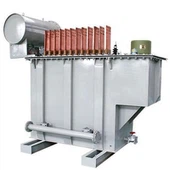
You can't just turn the "pressure" of electricity on or off like a tap. That important task is done by something called a transformer. Think of a transformer as the gearbox of the electrical grid. A car changes its gears to control the power and speed, and a transformer does the same thing with electricity by shifting it from high to low voltage so that it can be used for both long trips and short ones.
Right after the electricity is made, it goes into something called a "step-up" transformer at the power plant. This thing makes the voltage go way up, getting it ready for its big trip across the country on the power lines between towers. It's like putting the car in high gear before going on a long road trip so that it can travel far without using too much gas. Without these power transformers, there would be no such thing as high-voltage transmission. And when the power lines get close to our towns, the electricity goes to neighborhood substations. In this case, "step-down" transformers do the opposite job; they reduce the extremely high voltage down to a much lower, safe voltage for companies and houses. Transmission Substation is the last 'down-shift' that makes the power useful for your everyday life. Voltage has been controlled now, let's move on to the structures carrying the lines.
Anatomy of a Steel Giant: What Are the Parts of a Power Pylon?
While these may seem like a tangled mess of metal, the transmission towers are actually quite elegant. Main body is a lattice tower, which uses a crisscrossed pattern of beams to give it amazing strength and wind resistance using the smallest amount of materials possible. It's a skeleton, all it does is be tall and strong enough to hold up the heavy parts and take the weather. It is an engineering feat of efficiency, made to be sturdy but still somewhat light.
The skeleton has sticking out of it are the towers long arms called crossarms. Their job is easy yet vital: keep those strong electric lines away from each other and from the tower too. The voltage is so high that electricity can "jump" a surprisingly large distance through the air. Crossarms work as spacers, making sure there's a safe space of air between the wires so that electricity doesn't arc (jump) from one wire to another, which could create a big, dangerous short circuit.
Finally, the wires themselves. In the industry, they're not simply referred to as wires, they are conductors. They are usually made of aluminum, which is good at conducting electricity and is also very lightweight, wrapped around a steel core that provides the line with strength. This combo works well for going over long distances without too much sagging. But then we get to the big question: if all those conductors are carrying electricity and the tower is made out of metal, how come the electricity isn't just shooting right down into the ground? And that's when the most important thing you often forget about comes in.
The Most Important Part You Overlook: What the Glass Discs Do
It's the strings of glass or ceramic discs that you may have noticed hanging off the tower's arms. They are insulators, and they do one of the most important safety jobs on the whole electrical grid. Think of them as the rubber coating on your home's power cord, they're made to stop electricity dead in its tracks. High voltage conductor is connected to the bottom of the insulator string, and the top end is connected to the tower. And it makes a sort of non-electric barrier so that all that power in the line can never get to the metal tower and go down into the ground.
This important role is made possible by the fact that materials such as glass and porcelain do a poor job of conducting electricity. For the electricity flowing through the conductor, the insulator is simply a dead end. In front of this obstacle, the electricity has no other way but to go on with its planned route down the wire. Without these simple yet effective insulators, each and every transmission tower would turn into a massive, electrified danger, causing the whole system to short circuit. Here's something cool you can look for on your next road trip: how long the insulator string is tells you about how much power the line has. Higher voltages have a greater ability to "jump" across a gap, so they need more separation to be safely contained. A line with 765,000 volts may need a long string of thirty or more discs, whereas a 138,000-volt line could only need eight or ten. Therefore, the longer the string of insulators, the stronger the electricity it is holding back.
Lattice vs. Monopole: Why Don't All High-Voltage Towers Look the Same?
When you notice the transmission towers, you will find that they have different forms. Some are sprawling webs of steel, some are neat and simple poles. This kind of difference is not just about appearance, but rather a practical selection from among two primary types. The classic, crisscrossing one is a lattice tower. Its slimmer relative, frequently spotted alongside highways, goes by the name of a monopole pylon. Why do they look so different? It's usually because someone had to make a choice about whether to spend more money or use up more space on the ground.
Lattice towers are the workhorses of the industry due to their incredible strength and affordability, made from numerous small, angled pieces of steel. They have a web-like structure that's sturdy and durable, but it has one major downside – it takes up a huge amount of land. Four legs stretched out wide, they need a lot of room on the ground, so they usually have a long, empty path called a right-of-way. This makes them suitable for open country with lots of land. In contrast, the monopole pylon is the answer for tight spots. It is more costly to construct and set up, but it has a small footprint. One pole occupies much less space than a lattice tower, which is why it is suitable for crowded suburban areas or beside highways where there isn't enough room for a large lattice tower. Whether we choose a lattice tower or a monopole pylon comes down to the environment, and the kind of tower we use is just a practical response to the available space.

The Full Journey: From Power Plant to Your Plug Socket
Those steel towers marching across the landscape are the most obvious parts of a huge, linked-up electrical system. Think of them as the interstates on a nationwide highway network for electricity. But just as you can't take a car straight from the factory to your driveway without using local roads, electricity has to follow a similar multi-step journey to reach your home.
It starts at a power plant that makes electricity. To go on its long trip, the power gets made stronger (or "stepped up") by big machines called transformers to a very high voltage. It's similar to raising the water pressure so that a large volume can flow through a pipe with less energy lost. Transmission towers carry those high-voltage lines over hundreds of miles, making up the main part of the grid.
And eventually, it has to get off the highway. And that's what a transmission substation does – those big fenced-in places with all the transformers and equipment you may have noticed close to towns. Here, the high-voltage electricity gets "stepped down" into much lower, safer voltage. It is the crucial connection between the long-distance power grid and the local community's power grid. From the substation, the low-voltage electricity goes through the smaller, more familiar power lines that are usually hung up on wooden poles along city streets. These lines carry power to the last transformer near your house, which lowers the voltage one more time before it goes into your home and reaches your wall socket, waiting to be used. This huge amount of energy moving around is not always completely silent, so that's why you might sometimes hear some odd noises.
What's That Crackling or Buzzing Sound From High-Voltage Lines?
If you have been close to a big transmission tower before, you may have heard some kind of buzzing or crackling. This sound does not indicate any danger, it is simply a known and normal occurrence known as corona discharge. It's the sound of all that powerful electricity on the line interacting with all those air molecules right around it. It may seem like a fault, but it is actually a small, expected energy leak that occurs with very high voltages.
Imagine the huge electrical "pressure" in those lines. It's so powerful that it can make the air particles right next to the wire become electrically charged, or ionized. This is kind of like a little, constant spark, and all those tiny zaps together make the buzzing sound you hear. It is somewhat similar to the crackle of static electricity from a doorknob, except that it occurs continuously on a large scale. You might also notice that the sound is louder during wet, foggy, or rainy weather. Because humid air has more water droplets, and water provides a slightly easier path for electricity to energize the air near the conductor. This makes the corona effect stronger, so the buzz and crackle are more noticeable. So, this strong electrical field affects the air as it passes through it, but what happens if something else touches the wire?
Why Can Birds Sit on Power Lines But We Can't?
It's a classic, perplexing scene: a little bird can sit on a huge, high-voltage power line and not even have a single feather ruffled. And the answer is actually quite simple, and it all boils down to one basic principle of electricity. Electricity has to go somewhere for there to be a zap, and that means having a whole route for it to follow – an electrical circuit. It must move from a place with lots of energy to a place with less energy.
A bird landing on one wire will have its body and the wire at the same high electric potential. Since the bird does not make contact with the ground or another wire carrying a different voltage, there is no path for the electricity to flow through the bird. Current looks at the bird as a dead end and goes along the much easier way, the highly conductive metal wire. The bird is safe because it's not part of a circuit. A person on the ground, though, makes a dangerous situation. If you touched that same wire, your body would be the missing piece. Electricity would immediately find a new route from the high-voltage line, through you, and into the ground. Your body completes the circuit and allows a huge, lethal amount of energy to pass through it. That's why keeping away from fallen power lines is so important; you don't want to become part of electricity's path.
Are Power Lines Dangerous to Live Near? The Facts on EMF
One of the most frequent questions people ask regarding transmission towers is whether it poses any health dangers when living close to power lines. It's the electromagnetic field (EMF) that worries them – an invisible force of energy created by all electrical devices, including power lines.
To know the danger, one needs to know that not all radiation is created equal. Think about a ball being thrown: a soft toss with a tennis ball is harmless, but a baseball hurled at 100 miles per hour can be dangerous. Likewise, there are two primary kinds of radiation. High-energy, ionizing radiation such as x-rays have enough energy to cause harm to cells. But the energy from power lines is very low frequency and so falls under the non-ionizing category, which is also where EMFs from your home wiring and appliances belong.
After many years of doing lots of science work, big health groups all over the world have not found that being near power line EMFs can make people sick with things like cancer. Some earlier studies showed a small connection, but most of what we know doesn't show they hurt anyone. Also, the power of an electromagnetic field gets much smaller as you move farther away from it. The field is much weaker 50 feet away than right under the line, and even weaker inside a house. This principle of keeping a safe distance is one of the reasons why you see large, open areas of land around transmission towers.
What Is a "Right-of-Way" for Power Lines?
These large, clear strips of land that go along with the transmission towers aren't just empty spaces, they have a special name and use. This area is known as a Right-Of-Way (ROW). Think of it as a legally protected safety and access path that the utility company keeps up. It's important for keeping the power grid working well and people safe, making sure houses and other buildings are far enough away from danger.
Clearing trees near power lines mainly prevents dangerous situations. If a big tree grows too close, electricity might jump to it, which could cause a power failure or start a forest fire. During a storm, a falling tree branch can cut a line, leaving thousands without power. By keeping this corridor free of tall-growing plants, utilities stop those predictable and dangerous incidents from taking place. It's not just about avoiding nature; it's a vital way for workers to get around. When a tower or line requires an inspection or repair, workers must have a clear path to reach the location using large trucks and heavy equipment. Right-of-way makes sure that you can get through. This all brings up a logical question: if they need so much space on the surface, then why don't we just put all the power lines underground?
The Future: Why Aren't All Power Lines Buried Underground?
The simplest answer is cost. Burying local, neighborhood distribution lines is common, but burying the massive high-voltage transmission lines is no small feat. Specialized cables, lots of digging trenches, complicated cooling systems needed, so putting those lines underground costs 5-10 times as much as making big towers up in the air for a project covering hundreds of miles, which means the difference adds up to billions of dollars and that extra cost will end up being paid by people who use electricity.
Beyond that first cost, underground lines have a hard choice between being dependable and easy to fix. The benefits are obvious, they are safe from the wind, ice and falling trees, and they keep the nice view. But when something does go wrong, finding and fixing it is a huge pain. A fault on an overhead line can usually be seen by a helicopter within hours. A similar fault in a buried cable would take days, if not weeks, of digging and testing to find and fix, causing much longer outages. But technology is changing that calculation. A new method known as high voltage direct current (HVDC) transmission is making long distance underground and undersea projects more possible. Unlike the regular alternating current (AC) used by most parts of the grid, HVDC lines work better for very long distances and can be put underground or under water more easily. And this is how those massive offshore wind farms get connected to the mainland via cables that rest on the seabed, which could mean that more of our power grids might one day just disappear from view.
The Backbone of Modern Life
The silent, steel giants that you have seen all your life are no longer a mystery. The tangled mess of metal and wires that used to puzzle you has become clear as you can now see the beautiful design at work: the sturdy lattice frame, the extending crossarms that keep the lines separate, and the important glass insulators safeguarding the flow of electricity.
Next time you go for a drive, you can recognize the various tower forms and see the length of the insulator strings, which shows the voltage level of the line. Each tower is a visible link in an invisible system, a physical part of the massive challenge of transporting energy across the nation. These are more than just steel, these are the workhorses of our modern world. Every time you turn on a light switch, you will have a new respect for the amazing journey that electricity goes through from a far away power plant, over those high up wires, and straight to your hand.