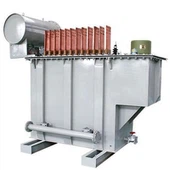
Power transformer, this seemingly ordinary equipment, in the power plant and substation but plays a vital role. It is like the "heart" of the power system, quietly and quietly for every family and every industrial power to provide a stable supply of electricity. The principle and technology behind this is far more complex than we think.
Imagine if there were no transformers, the power generated by a power plant might not be able to be efficiently transmitted to areas far away from where the power is used. This is because higher voltages mean less energy loss, but it is not safe to supply high voltages directly to homes or factories. This is where the transformer works its magic. It can raise the low voltage from a power plant to a high voltage suitable for long-distance transmission, and then lower the high voltage to a low voltage suitable for use in homes or factories.
This is not just a simple process of raising and lowering voltage, it is a highly sophisticated and safe process of converting electricity.
However, there are always some losses in the transmission of electrical energy. In order to minimize these losses, the engineers at Pilot Hi-Test Electro-Technology are constantly researching and improving transformer technology. They have found that by increasing the voltage, they can effectively reduce the energy loss during the power delivery process and improve the overall transmission efficiency. That's why we need transformers to raise the voltage and then lower it.
So how does a transformer work? There is actually a principle behind it based on electromagnetic induction. Simply put, when we apply an alternating current on one side of the transformer, it creates an alternating magnetic field. This magnetic field passes through the iron core inside the transformer and induces a current on the other side. This process adjusts the magnitude of the voltage and current according to the turns ratio of the windings, resulting in a step-up or step-down voltage.
When installing a transformer, we also need to pay attention to some issues. First of all, it should be located in a way that makes it easy for daily operation and maintenance, overhaul and transportation. In this way, when the transformer has problems, we can quickly repair and replace it. Secondly, the transformer should be installed in a safe place to avoid damage due to natural disasters such as lightning and flooding.
Of course, it is also very important to choose the right rated capacity of the transformer. If the capacity is selected too large, it will not only increase the initial investment cost, but also may keep the transformer in no-load or light-load state for a long time, resulting in increased no-load loss and lower power factor, which in turn causes unnecessary network loss. On the contrary, if the capacity is selected too small, the transformer may be overloaded for a long time, which will not only shorten the service life of the equipment, but also may cause safety accidents. Therefore, we need to reasonably determine the rated capacity of the transformer according to the actual power load to ensure that it operates within an economically reasonable range.
In conclusion, power transformer plays a vital role in the power system. It not only provides a stable power supply for our life, but also determines the operation efficiency and safety of the power system to a large extent. Therefore, we should understand and pay more attention to this equipment to ensure its normal operation and maintenance.
Follow us and you will learn more about transformers and energy conversion.
Hevin Tang
---------------------------------------------------------------------------------
Jiangsu Yawei Transformer Co.,Ltd.
Jiangsu Yawei Electric Power Engineering Co.,Ltd.
Add: No.265,West Huanghai Avenue,Haian City, Jiangsu Province,China
Hevin Tang (Export Manager)
Wechat:Hevin88888
Mob/WhatsApp: +86 188 6272 9569
Email:Hevin@yaweitransformer.com
Web: www.yaweitransformer.com