

Let's be real-transformers don't magically convert all input power into useful output. They're pretty efficient, sure, but there's always some energy that gets "soaked up" and turned into heat. That heat mainly comes from two big buckets of loss:
Core losses (iron losses)
Copper losses (winding losses)
If you understand these losses, you can do a lot better with efficiency, thermal design, and running costs. And honestly, transformer losses aren't just a theoretical thing-those losses directly affect how much you pay and how long the equipment stays healthy.
Types of Transformer Losses
Core Losses (No-Load Losses)
Core losses are mostly there even when the transformer isn't heavily loaded. That's why they're often called no-load losses-they stay fairly constant with load.
Core losses typically include:
Hysteresis loss: energy used to keep flipping the magnetic domains around in the core material
Eddy current loss: currents induced in the laminations, which also turn into heat
How are core losses measured?
They're measured using the Open Circuit (OC) test:
Rated voltage is applied to the primary
The secondary is left open-circuited
The wattmeter reading gives you the core loss, usually written as 
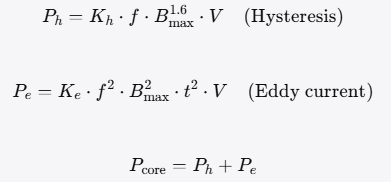
Approximate core-loss relationships
Engineers often use simplified formulas like these (good for understanding trends, though real transformers are never "perfect"):
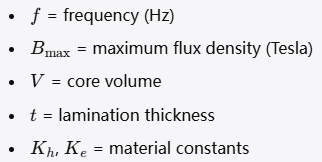
Where:
Copper Losses (Load Losses)
Copper losses happen because current flows through the windings. And whenever current flows through resistance, you get heating-classic  .
.
Key point: copper losses grow with the square of load current, which means they can ramp up fast when the transformer is loaded more heavily.
How are copper losses measured?
They're found using the Short Circuit (SC) test:
One winding is shorted
Voltage is gradually applied to the other winding until rated current circulates
The wattmeter reading is the full-load copper loss, often called 
Copper loss at any load level
If the load current is  and the rated current is
  , then:
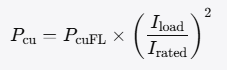
So yes-if you load the transformer to 50%, copper losses don't halve; they drop to about a quarter. That's the "square" effect doing its thing.
Transformer Efficiency Calculation
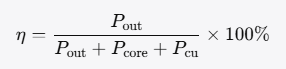
Transformer efficiency tells you how much useful power you actually get out, compared to what you spend including losses:
A more practical way (using kVA, PF, and load fraction)
In real-world calculations, it's common to use kVA rating and power factor (PF). One practical form is:

When does efficiency peak?
Peak efficiency usually happens when:
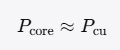
And in many distribution transformers, that "sweet spot" often lands around 50–70% of full load. (Not a law of nature, but it's a common pattern.)
Practical Example (Worked Scenario)
Let's say we have a 500 kVA, 11 kV/415 V distribution transformer with manufacturer test data:
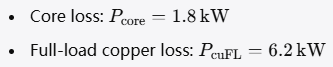
Copper loss at a given load
If the load is  , then:
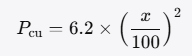
For example, at 50% load:

That's pretty close to the core loss (1.8 kW), which explains why the efficiency is often highest around that loading level.
Losses and Efficiency at different loads (Unity PF)
(Using unity PF as in your original example.)
| Load (%) | Load kVA | Copper Loss (kW) | Total Loss (kW) | Output (kW) | Efficiency (%) |
|---|---|---|---|---|---|
| 25 | 125 | 0.39 | 2.19 | 125 | 98.27 |
| 50 | 250 | 1.55 | 3.35 | 250 | 98.68 |
| 75 | 375 | 3.49 | 5.29 | 375 | 98.61 |
| 100 | 500 | 6.20 | 8.00 | 500 | 98.43 |
Factors That Affect Transformer Losses
Losses don't just "happen"-they're influenced by a bunch of design and operating details, such as:
Core material
Better materials (like high-grade silicon steel or amorphous alloys) usually reduce hysteresis.
Design flux density
Lower  helps core losses-but it may require more core size.
Winding resistance
Thicker conductors / lower resistance generally reduce copper losses.
Temperature
Resistance increases with temperature, so copper losses rise too. (Often corrected to a standard, like 75°C, depending on IEC/IEEE conventions.)
Harmonics in the load
Non-linear loads can add extra eddy currents and stray losses-so the "actual loss" can be worse than what you'd expect with a nice clean sinusoidal load.
Typical Loss Distribution (Rule of Thumb)
Different types/sizes of transformers tend to split losses differently. A common rough guide is:
Smaller distribution transformers: core loss might be ~25–40%, copper ~60–75%
Power (larger) transformers: core loss ~30–50%, copper ~50–70%
Again, it varies by design-but it's a useful mental picture.
Wrap-Up / Conclusion
If you calculate transformer losses accurately, you can make smarter decisions about:
how to size the transformer,
how to load it efficiently,
and how to plan maintenance before things get costly.
OC and SC tests give solid real-world data, but modern transformer engineering often goes beyond that-using finite element analysis to estimate things like stray losses and hot-spot temperatures (where failure risks tend to hide).
With rising electricity prices and stronger efficiency requirements worldwide (think DOE/EU-style initiatives), minimizing losses isn't just "nice to have" anymore-it's a real economic and environmental priority.
Bottom line: always check nameplate data and follow standards like IEC 60076 when you need certified loss values.


