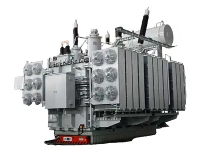
Understanding the Role of Electric Substations
An electric substation is a grid facility that changes voltage, connects circuits, and houses equipment for controlling and protecting electricity delivery. It helps link power generation with the transmission and distribution networks that serve homes and businesses. Understanding its equipment and design makes it easier to see how electrical infrastructure supports everyday service-and why upgrades matter.

What does an electric substation do?
An electric substation performs one or more essential functions: transforming voltage, switching electrical connections, monitoring operating conditions, and isolating faults. Not every substation changes voltage; some primarily connect or separate circuits operating at the same voltage. Its role depends on where it sits in the network and what that network needs.
Voltage transformation helps electricity travel efficiently. Higher voltages make long-distance transmission more efficient, while lower voltages are needed for local distribution and customer service. Transformers provide these transitions at appropriate points along the electricity delivery path.
Substations also provide controlled connection points. Circuit breakers can disconnect faulted sections, while switching arrangements allow operators to isolate equipment for maintenance. These capabilities help manage disturbances, although they cannot guarantee uninterrupted service during every equipment failure or severe event.

The main types of substations
Substations are commonly described by their function rather than their appearance. A large outdoor installation and a compact enclosed facility may perform similar tasks, while neighboring facilities may serve different network purposes. The most useful distinction is what each does to connect generation, transmission, and distribution.
| Substation type | Main purpose | Practical significance |
|---|---|---|
| Step-up | Raises voltage near a generating facility | Prepares electricity for efficient transmission over longer distances |
| Transmission | Connects high-voltage circuits, sometimes at different voltages | Links major parts of the grid and supports bulk electricity transfer |
| Distribution | Reduces voltage for local distribution circuits | Supplies the lines serving neighborhoods, businesses, and other customers |
| Switching | Connects or disconnects circuits without necessarily transforming voltage | Supports network reconfiguration and equipment isolation |
These categories can overlap. A transmission facility may also include transformers that supply local distribution. High voltage substations should therefore be understood as functional parts of a larger network, not as identical installations with interchangeable capabilities.
A distribution substation usually does not reduce electricity directly to household outlet voltage. Additional transformers farther along the distribution network commonly provide the final reduction for residential service. Large industrial customers may receive electricity at higher service voltages suited to their facilities.
The equipment inside a substation
A substation works as a coordinated system, not simply as a collection of transformers. Power equipment carries electricity, while measurement, protection, and control equipment help determine when connections should remain closed or open. The exact combination varies with the installation's purpose and electrical requirements.
Transformers and electrical connections
Power transformers change alternating-current voltage through electromagnetic induction. Their coils and magnetic core transfer energy between circuits, with the winding arrangement determining whether voltage rises or falls. They change the voltage level rather than generate electricity.
Busbars are conductors that provide common connection points for multiple circuits and pieces of equipment. Circuit breakers interrupt current, including fault current within their ratings. Disconnect switches provide isolation as part of an appropriate switching procedure; their role should not be confused with a circuit breaker's fault-interruption function.

Protection, measurement, and control
Protective relays use electrical measurements to detect conditions that call for disconnection and send trip commands to circuit breakers. Instrumentation also gives operators information about system performance. Depending on the installation, voltage-control equipment may include capacitors, reactors, or other devices that help manage network conditions.
This separation between detection and interruption matters. A relay identifies a condition requiring action; the breaker physically opens the circuit. Reliable protection depends on these components working together, so asset management must address control systems as well as primary electrical equipment.
How does electric substation design support reliability?
Electric substation design supports reliability by matching equipment ratings, electrical layout, protection, and physical arrangements to the network's operating requirements. Engineers must consider normal power flows as well as faults, maintenance, and potential equipment outages. There is no universal layout that provides the best answer for every location.
For a non-specialist reviewing a proposed project, these questions provide a useful starting point:
Electrical duty: What voltages and power transfers must the equipment accommodate, and what fault conditions must it withstand?
Connection arrangement: Which circuits or transformers would lose service if a particular component were disconnected?
Maintenance access: Can qualified personnel safely inspect, isolate, and maintain equipment with sufficient working space?
Site constraints: How do available land, the shape of the site, and incoming connections influence the layout?
Future changes: Can the arrangement accommodate additional connections, or would expansion require substantial rebuilding?
These considerations connect technical decisions with practical operating consequences. A layout that fits the available land may offer different maintenance or expansion options from one with more space. Likewise, different bus arrangements affect how equipment can be connected and isolated, making configuration an important part of project evaluation.
Air-insulated and gas-insulated arrangements
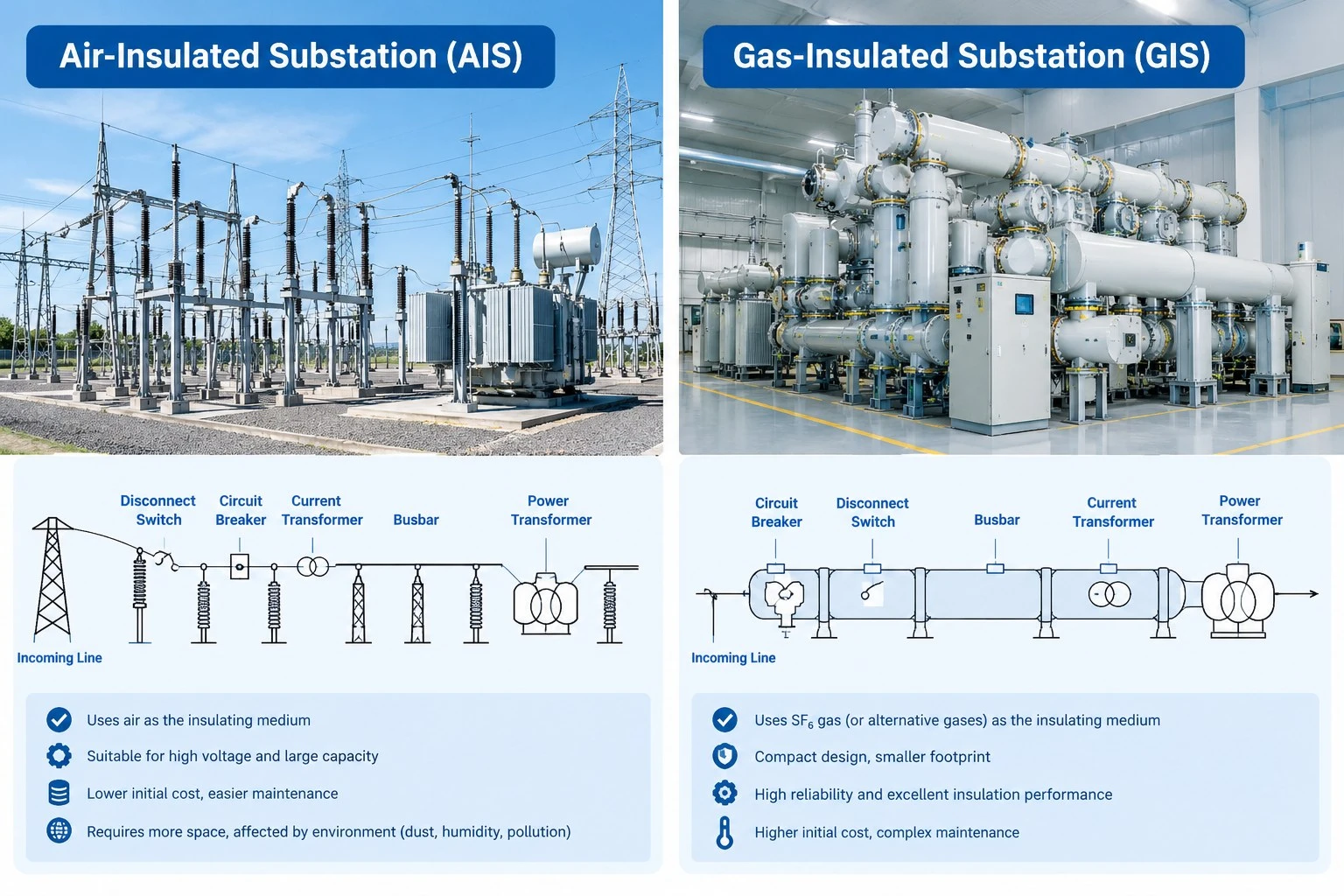
Air-insulated substations use air gaps to provide insulation between exposed electrical components. They generally require more space, but their open arrangement supports visual inspection and access to individual components. Gas-insulated substations enclose equipment within insulating gas systems, allowing a smaller footprint where land is constrained.
Neither arrangement is automatically superior. Selection involves space, construction cost, environmental considerations, and maintenance requirements. Compact equipment can solve a siting problem, but specialized maintenance needs remain part of the decision.
Substation technology and the connected grid
Digital substation technology extends protection, monitoring, and control through electronic devices and communications networks. These systems can make operating information available beyond the substation itself. They complement transformers and switching equipment rather than eliminate the need for physical power-handling assets.
The practical value lies in better visibility and coordinated control. Operators need trustworthy information to understand changing grid conditions and manage equipment. As more assets exchange data, protecting communications and control signals becomes an essential part of reliable operation, not a separate administrative concern.
Distributed energy resources add another dimension. Solar installations and other connected resources exchange information with utility distribution control systems to help manage electricity flows. Secure monitoring, authentication, access control, and data integrity are therefore important considerations when expanding connected electrical infrastructure.
Finding and understanding a nearby substation
If you search for "electric substation near me," first identify what you need to know: the facility's operator, a proposed development, an outage, or a potential electricity connection. For an outage or connection inquiry, start with the local utility responsible for operating the distribution system. That organization delivers electricity locally even where customers buy their energy from another supplier.
For a property or development inquiry, ask the utility to assess your actual requirements rather than treating a nearby facility as proof of available capacity. Useful questions include the following; these are discussion prompts, not assumptions about what a particular site can provide:
Which utility team handles service requests for this address?
What demand and project information should I submit?
Does the proposed connection require a network assessment?
Who can explain any associated substation or line work?
Keep all inquiries outside the facility. Substations contain potentially deadly high-voltage equipment, and fences and warning signs mark restricted areas. Never climb a fence or enter to retrieve an object; contact the utility instead. For an electrical emergency, stay away and call 911.
Substations as a foundation for dependable electricity
Substations make the grid usable by connecting its different voltage levels and providing places to switch, monitor, and protect circuits. Their contribution depends on coordinated equipment and a design suited to the network, not simply on size or proximity. Understanding those functions gives residents and project planners a better basis for discussing service, infrastructure improvements, and future electricity needs.
FAQ
Q: How soon can you delivery the transformer?
A: It depends on the quantity and capacity of the transformer, normally within one month since the date drawing confirmed by buyer.
Q: How long can you provide the quality warranty?
A: 24 months since the date transformer operated.
Q: What payment method do you accept?
A: T/T (wire transfer) preferred, L/C both accepted.