

How Solid State Transformers Could Improve EV Charging Infrastructure
The rapid growth of electric vehicles (EVs) is creating new demands on power distribution systems. Public charging stations, highway fast-charging hubs, commercial fleets, and electric bus depots all require reliable electricity, often at high power levels. As charging demand increases, conventional transformers and existing grid infrastructure may face challenges related to capacity, space, power quality, and energy management.
Solid state transformers (SSTs) are an emerging technology that could help address these challenges. Unlike conventional transformers, which rely primarily on electromagnetic induction, solid state transformers combine power electronics with high-frequency transformers and advanced control systems. This approach offers greater flexibility in voltage conversion and power flow management, making SSTs a promising option for future EV charging infrastructure.
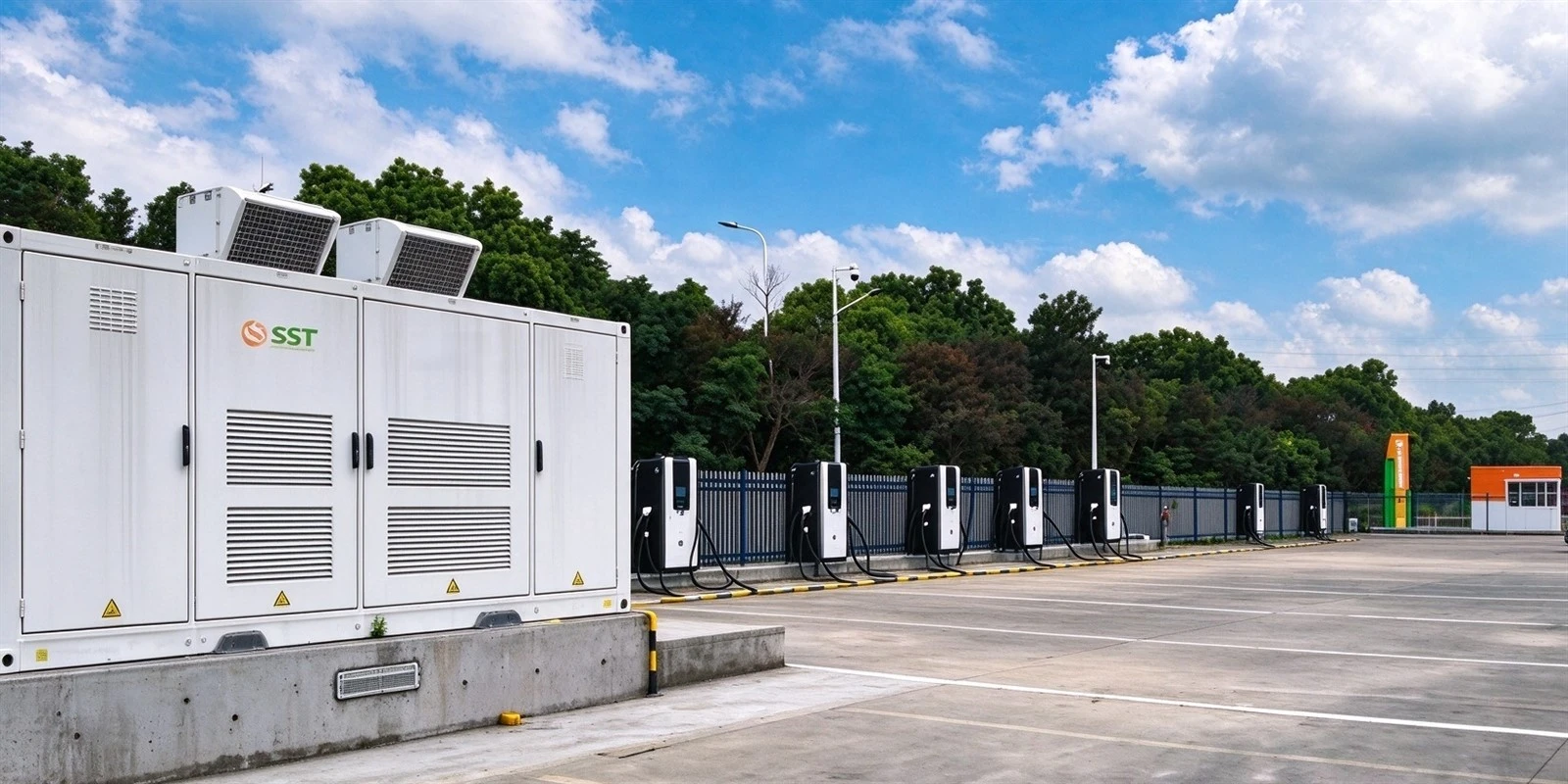
What Is a Solid State Transformer?
A solid state transformer is an advanced power conversion device that uses semiconductor switches and high-frequency magnetic components to convert electrical power between different voltage levels. Depending on its design, it can convert AC power to DC, DC power to AC, and manage power flows between multiple electrical ports.
A typical solid state transformer consists of three main stages: an AC-to-DC converter, an isolated DC-to-DC converter, and a DC output stage or DC-to-AC inverter. These stages work together to provide voltage conversion, electrical isolation, and controlled power delivery.
Compared with conventional transformers, SSTs can offer additional functions such as active power factor correction, bidirectional power flow, and dynamic voltage regulation. However, their cost, efficiency, thermal management requirements, and long-term reliability remain important considerations for commercial deployment.
1. Supporting Ultra-Fast EV Charging
One of the most important potential benefits of solid state transformers is their ability to support high-power EV charging systems.
Modern DC fast-charging stations may require hundreds of kilowatts per charging connector, while large charging hubs can demand several megawatts of power. Conventional grid connections may require multiple conversion stages, additional equipment, and substantial space to accommodate this demand.
A solid state transformer can integrate medium-voltage power conversion with DC output capabilities, depending on the system architecture. This may simplify the electrical path between the medium-voltage grid and high-power charging equipment.
For charging operators, a well-designed SST-based system could improve power distribution flexibility and help reduce the footprint of some installations. These advantages are particularly relevant to highway service areas, urban charging stations, and fleet depots where available space is limited.
2. Improving Energy Efficiency and Power Quality
Efficiency is a key consideration for EV charging infrastructure because even small conversion losses can become significant at megawatt-scale facilities.
Solid state transformers use controlled power electronic conversion to regulate voltage and current. Their active control capabilities can help manage harmonics, improve power factor, and respond to certain grid disturbances. This may reduce the need for separate power quality equipment in some applications.
However, solid state transformers do not automatically outperform conventional transformers in every efficiency comparison. Their semiconductor devices introduce switching and conduction losses, and the complete system's efficiency depends on the operating voltage, load profile, switching frequency, cooling arrangement, and conversion stages.
When evaluating an SST for an EV charging project, engineers should compare measured system-level efficiency across realistic operating conditions rather than relying only on the advantages of power electronics.
3. Enabling Bidirectional Power Flow and Vehicle-to-Grid Integration
Future EV charging infrastructure may do more than charge vehicle batteries. With vehicle-to-grid (V2G) technology, compatible EVs can potentially return stored energy to the electrical grid when needed.
Bidirectional solid state transformers could help manage this two-way power flow. During charging, electricity moves from the grid to the vehicle. During discharge, the system can control the transfer of energy in the opposite direction, subject to the vehicle, charger, interconnection, and grid operator requirements.
This capability could support peak-demand management, frequency regulation, and the integration of distributed energy resources. For commercial fleets, it may also create opportunities to coordinate charging schedules with electricity prices and facility demand.
An SST does not independently enable V2G. The charging equipment, vehicle communication protocols, protection systems, and utility interconnection must all support bidirectional operation.
4. Integrating Solar Power and Battery Energy Storage
EV charging stations are increasingly being designed alongside rooftop solar installations and battery energy storage systems (BESS). These resources can help reduce peak grid demand and improve the use of renewable electricity.
Solid state transformers can potentially connect these different resources through controlled AC and DC power interfaces. For example, a charging hub could use solar generation during the day, charge stationary batteries when electricity is available, and discharge stored energy during periods of high charging demand.
A suitably designed SST-based architecture may reduce conversion stages between compatible DC resources and charging equipment. It can also provide more flexible control of power distribution.
The actual benefits depend on system design, component compatibility, energy management software, and the cost of the complete installation.
5. Reducing Space Requirements and Improving Scalability
Land and electrical infrastructure costs can be significant for urban charging stations and large fleet facilities. Traditional installations may require transformers, switchgear, rectifiers, distribution panels, and other equipment arranged in separate enclosures.
By integrating several conversion functions, solid state transformers may reduce the footprint of some power distribution systems. Their modular architecture could also make it easier to expand charging capacity as demand increases.
Nevertheless, SST systems still require appropriate protection, cooling, isolation, and maintenance access. Their power density and overall installation size must be assessed against the complete system, not the transformer alone.
6. Challenges to Commercial Adoption
Despite their potential, solid state transformers face several barriers to widespread deployment. High initial costs, semiconductor reliability, cooling requirements, fault protection, and limited field experience at large power ratings can affect project economics.
Conventional oil-immersed and dry-type transformers remain mature, widely available solutions with established maintenance practices and strong performance in utility and industrial applications. For many EV charging projects, they continue to offer a practical and cost-effective choice.
Before selecting an SST, project developers should assess total lifecycle cost, operating efficiency, expected utilization, maintenance requirements, and compatibility with existing medium-voltage infrastructure.
Conclusion
Solid state transformers could play an important role in the next generation of EV charging infrastructure. Their potential advantages include flexible power conversion, bidirectional energy flow, improved power quality control, and easier integration with renewable energy and battery storage systems.
However, SSTs are an emerging alternative rather than a universal replacement for conventional transformers. The right solution depends on charging capacity, grid conditions, installation space, budget, and long-term operating requirements.
For EV charging developers and electrical engineers, selecting the right transformer remains essential to building reliable, scalable, and efficient charging networks. Experienced transformer manufacturers such as Jiangsu Yawei Transformer Co., Ltd. can support project teams evaluating conventional transformer solutions for charging stations, fleet depots, and other high-demand power distribution applications.
FAQ
Q: How soon can you delivery the transformer?
A: It depends on the quantity and capacity of the transformer, normally within one month since the date drawing confirmed by buyer.
Q: How long can you provide the quality warranty?
A: 24 months since the date transformer operated.
Q: What payment method do you accept?
A: T/T (wire transfer) preferred, L/C both accepted.


