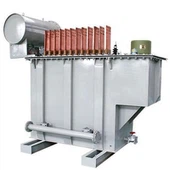
What's a Low Voltage Landscape Lighting Transformer Anyway?
In plain English, a low voltage landscape lighting transformer is the thing that takes the standard power from your house(usually 120V or 230V) and cranks it down to a much safer level-typically 12V or 24V. That lower voltage is what powers things like path lights, spotlights, deck lights, and those little garden accent lights.
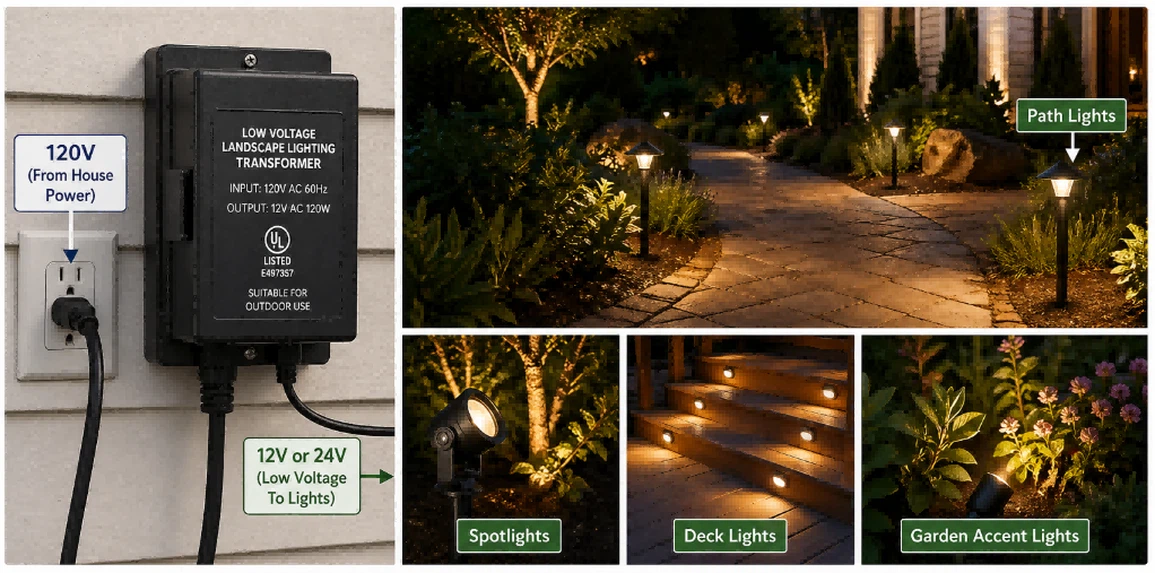
Why go through all that trouble? Two main reasons:
Safety first. Lower voltage means way less chance of getting shocked-especially important outside where things get wet.
It just works. Most outdoor lighting fixtures are designed for low voltage systems.
Think of the transformer as the middleman between your home's electrical system and your yard lights.
How the Little Guy Works
It's not magic, though it kind of seems like it. Inside the transformer, you've got two sets of wire coils: one connected to the high-voltage input (primary), and one that sends out the lower voltage (secondary).
When electricity hits the primary coil, it creates a magnetic field. That field then nudges a lower voltage out of the secondary coil. The number of wire twists (turns) in each coil determines how much the voltage drops.
End result? A steady, low-voltage feed that won't fry your outdoor lights.
What's Inside One of These Things?
A typical landscape transformer has a few key parts:
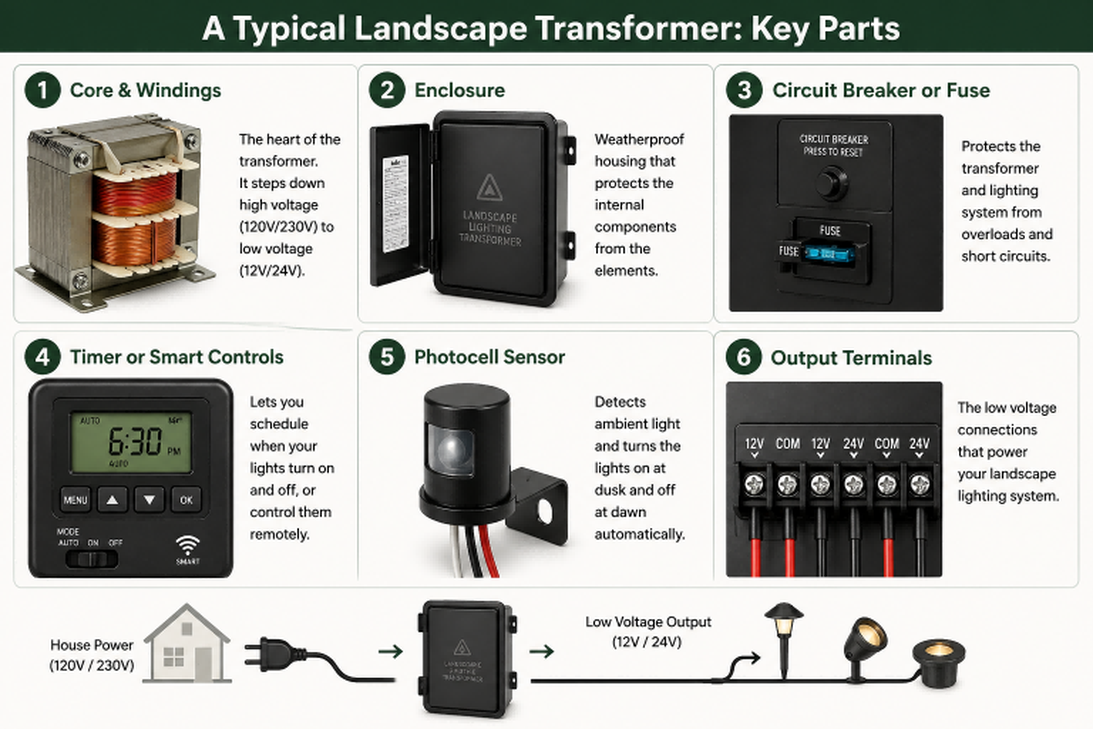
Core & windings – The guts that do the actual voltage conversion. Usually made of layered steel to cut down on energy loss.
Enclosure – The outer box. Needs to be weatherproof and rust-resistant if it's living outside.
Circuit breaker or fuse – Your safety net. Stops things from melting down if there's a short or overload.
Timer or smart controls – Lets the system turn on and off automatically. Pretty handy.
Photocell sensor – Senses daylight. Turns lights on at dusk, off at dawn. Set it and forget it.
Output terminals – Where you actually hook up the low voltage cables to run power to your lights.
Types of Transformers – Not All Are Created Equal
You've got options. Here's the quick rundown:
Magnetic transformers – Old school, heavy, and tough as nails. They last forever and just keep working.
Electronic transformers – Smaller and lighter. More energy-efficient, but maybe not as happy in really harsh weather.
Smart transformers – Fancy ones that connect to your phone or home automation. App control, schedules, energy tracking-the works.
Picking the Right One – Don't Mess This Up
Choosing the wrong transformer is a headache you don't need. Here's what to keep in mind:
1. Wattage
Add up all your light bulb wattages. Then grab a transformer that has 20–30% more capacity than that number. Trust me-you'll want that extra room for later.
2. Voltage options
Some transformers have multiple taps (12V, 13V, 14V). Super useful when you're running long cable runs and voltage starts to drop.
3. Where you put it
Outdoors? Get one rated for outdoors. Look for weatherproof and UV-resistant. Rain and sun will kill a cheap box fast.
4. Controls
Pick your poison: basic on/off, a simple timer, or a full smart system.
5. Build quality
You get what you pay for. Good seals and solid materials matter when it's sitting through snow and humidity.
How to Install One – The Short Version
Installing one of these isn't rocket science, but don't get sloppy.
Step 1 – Mount it
Stick it near a power outlet, on an exterior wall. Keep it off the ground so water doesn't sneak in.
Step 2 – Plug it in
Use a GFCI outlet. That's the one with the test/reset buttons. Way safer.
Step 3 – Run your cable
Lay the low voltage cable where you want your lights. No sharp bends. Don't run it over with the mower.
Step 4 – Hook up fixtures
Connect each light to the cable with proper connectors.
Step 5 – Test it
Flip it on. Make sure everything lights up.

Why Bother with Low Voltage?
Good question. Here's why people go this route:
Safer – Way lower shock risk.
Cheaper to run – Especially with LEDs.
Easy to install – No burying conduit in most cases.
Flexible – Add lights later without redoing everything.
Looks great – Soft, classy lighting.
Common Problems (and How to Fix 'Em)
Voltage drop – Lights at the end of the line look dim.
Fix: Use thicker cable or a transformer with higher voltage taps.
Overloading – Too many lights for the transformer.
Fix: Get a bigger transformer or split the load.
Weather damage – Rain and moisture cause problems.
Fix: Weatherproof enclosure. Good seals. Don't skip this.
Keeping It Alive – A Little Maintenance Goes a Long Way
Look for rust or loose wires every now and then.
Wipe off the enclosure so dirt doesn't build up.
Check that timers and sensors are still doing their job.
Swap out damaged cables or connectors fast.
A little care now saves you headaches later.
The Bottom Line
Look, the transformer isn't the flashiest part of your landscape lighting setup. But it's the workhorse. It quietly does the important job of making high-voltage house power safe for your yard lights.
Whether you're just lighting a little garden path or going all out on a big landscape project, pick the right transformer, treat it decently, and it'll keep your outdoor spaces looking beautiful for years. No drama.