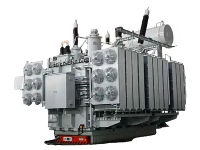
When people talk about modern power systems, transformers usually don't get much attention outside the electrical industry. But honestly, they're doing an enormous amount of heavy lifting behind the scenes. Among them, the 220kV oil-immersed three-phase double-winding transformer with on-load tap changing (OLTC) capability is one of the real workhorses of the grid.
These transformers are mainly used to step voltage up or down between different parts of the transmission and distribution network. In many cases, they reduce 220kV transmission voltage to lower levels like 132kV, 66kV, 33kV, or even 11kV for regional supply and industrial use.
What makes them especially valuable is the OLTC system. Instead of shutting the transformer down to adjust voltage, operators can change tap positions while the transformer is still energized and carrying load. That may sound like a small feature, but in real-world grid operation, it makes a huge difference.

Why Oil-Immersed Transformers Are Still Widely Used
Even with newer technologies entering the market, oil-immersed transformers remain the preferred option for many utilities. The reason is pretty straightforward: they work well, they last long, and they can handle serious power levels reliably.
The insulating oil serves two important purposes at the same time. First, it provides electrical insulation between internal components. Second, it removes heat generated by the windings and core during operation. Without proper cooling, transformers would overheat very quickly under heavy load conditions.
Most large 220kV units use cooling methods such as ONAN (Oil Natural Air Natural) or ONAF (Oil Natural Air Forced). In higher-capacity installations, forced oil circulation systems may also be used to improve heat dissipation.
The transformer core itself is usually made from grain-oriented silicon steel, which helps reduce energy losses. Copper windings are commonly used because they offer excellent conductivity and thermal performance. Utilities care a lot about efficiency here because even a small reduction in losses can save significant energy over the life of the transformer.
And these units are built to last. With proper maintenance, many operate for 30 years or more without major problems.

A Key Part of Transmission Networks
In transmission systems, 220kV transformers act as connection points between voltage levels. Electricity generated at power plants often travels long distances at very high voltages to minimize transmission losses. Before that power can be distributed locally, the voltage needs to be reduced in stages.
That's where these transformers come in.
For example, a substation may receive power at 400kV or 500kV and step it down to 220kV. Another transformer then reduces it further for regional distribution networks.
Voltage regulation becomes especially important in these situations because transmission loads are constantly changing. During peak demand periods, voltage can drop significantly across long lines. On the other hand, lightly loaded systems sometimes experience voltage rise issues.
The OLTC helps balance all this automatically. By adjusting the transformer turns ratio in real time, the system keeps voltage levels within acceptable limits without interrupting supply.
To put it simply, the transformer is continuously "fine-tuning" the grid behind the scenes.
Supporting Cities and Urban Power Demand
Urban substations are another major application area.
Big cities consume enormous amounts of electricity every day, and demand patterns can change pretty fast. Air-conditioning loads, commercial buildings, transportation systems, and residential consumption all create fluctuations throughout the day.
A typical urban substation may use several 220/66kV or 220/33kV transformers operating in parallel. Their OLTC systems work together to maintain stable voltage for downstream consumers.
If voltage drops too low, equipment performance suffers. If it rises too high, sensitive devices may be damaged. Neither situation is ideal, obviously.
In crowded metropolitan areas where land is limited, utilities often combine these transformers with GIS (Gas Insulated Switchgear) systems to reduce substation footprint. It's a more compact arrangement and works well in dense urban environments.
Renewable Energy Integration
Renewable energy projects have changed the way power systems operate, and transformers now play an even bigger role than before.
Large wind farms and solar plants commonly generate electricity at medium voltage levels such as 33kV or 66kV. Before power can enter the transmission network efficiently, it needs to be stepped up to 220kV.
But renewable generation is not perfectly stable. Wind speed changes. Cloud cover affects solar output. Power flow can fluctuate throughout the day, sometimes very quickly.
This variability creates voltage challenges for grid operators.
OLTC-equipped transformers help smooth out these fluctuations by automatically regulating voltage at the grid connection point. In projects that include battery energy storage systems, transformers also support bidirectional power flow, which is becoming increasingly important in modern smart grids.
Honestly, without advanced transformer regulation, integrating large amounts of renewable energy would be much harder.
Industrial Applications
Heavy industries also depend heavily on 220kV transformers.
Steel plants, mining operations, petrochemical facilities, and large manufacturing sites consume huge amounts of electrical power. Many of these facilities operate their own dedicated substations connected directly to the high-voltage network.
Industrial loads can be very demanding. Large motors, arc furnaces, and variable-speed drives often create sudden voltage dips and load swings. Sensitive production equipment doesn't respond well to unstable power conditions.
That's why voltage regulation matters so much in industrial environments.
OLTC transformers help stabilize supply during changing load conditions, reducing the risk of equipment trips and production interruptions. In continuous-process industries, even a brief outage can lead to massive financial losses, so reliability is absolutely critical.
Maintenance and Future Development
Even though these transformers are extremely reliable, they still require regular maintenance. Utilities routinely monitor oil condition, winding temperature, moisture content, and dissolved gases to detect potential issues early.
Modern monitoring systems now allow real-time condition assessment through sensors and digital diagnostics. Instead of relying only on scheduled inspections, operators can predict problems before failures happen.
Looking ahead, transformer technology continues evolving. Manufacturers are improving core materials, developing environmentally friendly insulating fluids, and adding smart monitoring capabilities. Digital substations and grid automation are pushing transformers toward becoming more intelligent and connected assets.
Still, the basic mission remains the same.
The 220kV oil-immersed three-phase double-winding OLTC transformer continues to serve as one of the backbone components of modern electrical infrastructure. Whether it's supporting transmission networks, powering cities, integrating renewables, or supplying heavy industry, these transformers quietly keep electricity moving where it's needed-day after day, year after year.