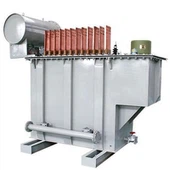
Each electrical equipment will experience losses during long-term operation, and power transformers are no exception. In the losses of power transformers, they are mainly divided into two parts: copper losses and iron losses.

Copper loss
Definition
Copper plays an important role in power transformers, and copper wires are usually used in the windings of transformers. The "copper loss" in transformers refers to the loss caused by copper wires. The "copper loss" of a transformer, also known as load loss, is a variable loss that varies. When the transformer operates under load, there will be resistance when the current passes through the wire, resulting in resistance loss. According to Joule's law, the current flowing through this resistor will generate Joule heat, and the larger the current, the greater the power loss. Therefore, the resistance loss is proportional to the square of the current and independent of the voltage. It is precisely because it changes with the magnitude of the current that copper loss (load loss) is a variable loss and the main loss during transformer operation.

Influence factor
Current magnitude: As mentioned above, copper loss is directly proportional to the square of the current, so the magnitude of the current is a key factor affecting copper loss.
Winding resistance: The resistance of the winding directly affects copper loss. The higher the resistance, the higher the copper loss.
Number of coil layers: The more coil layers there are, the longer the path for current to flow in the winding, and the corresponding resistance will increase, resulting in increased copper loss.
Switching frequency: The impact of switching frequency on transformer copper loss is directly related to the distribution parameters and load characteristics of the transformer. When the load characteristics and distributed parameters exhibit inductive characteristics together, copper loss decreases with the increase of switching frequency; When exhibiting capacitive characteristics together, copper loss increases with the increase of switching frequency.
Temperature effect: Load losses are also affected by the temperature of the transformer, and leakage flux caused by load current will generate eddy current losses inside the winding and stray losses in the metal parts outside the winding.
Methods to reduce copper loss
Increasing the cross-sectional area of transformer windings: reducing conductor resistance, thereby effectively reducing copper losses in transformers.
Using high-quality conductor materials such as copper foil or aluminum foil to reduce winding resistance.
Reducing the light load operation time of transformers: Limiting the proportion of light load operation time of transformers is beneficial for reducing copper losses of transformers.
Iron loss
Definition
Unlike copper loss, iron loss in transformers is not related to factors such as winding and current size. As the name suggests, iron loss is related to iron and is generated by the iron core. The iron loss of a transformer is also known as "no-load loss" because it exists in both full load and zero load states of the transformer and is a fixed loss of the high voltage transformer. However, in the load, power loss will decrease as the electric field strength decreases.
classification
The iron loss of transformers is divided into hysteresis loss and eddy current loss.
The working principle of hysteresis loss transformer is based on the principle of electromagnetic induction to achieve voltage rise and current change. The magnetic flux inside the transformer flows on the iron core, which has magnetic resistance to the magnetic flux, just like a conductor has resistance to current, and also generates heat. This type of loss is called "hysteresis loss"
Eddy current loss: When the primary winding of a transformer is energized, the magnetic flux generated by the coil flows through the iron core. Because the iron core itself is also a conductor, an electric potential is induced in a plane perpendicular to the magnetic field lines. This electric potential forms a closed loop on the cross-section of the iron core and generates current, like a vortex, so it is called "eddy current". The loss generated by this eddy current is called "eddy current loss". It is precisely because the iron core generates eddy currents that it is made into a thin piece, because the thinner it is, the greater the resistance and the smaller the current.

Influence factor
Working voltage and frequency: Iron loss is related to the working voltage and frequency of transformers, as these factors can affect the magnetic field strength and hysteresis phenomenon in the iron core.
Core material: The hysteresis properties of the core material can affect the magnitude of iron loss. If the iron core material is not selected properly, the hysteresis loss will increase.
Manufacturing process: The manufacturing process of transformers also has a certain impact on iron loss. For example, the stacking method and insulation treatment of the iron core can affect the size of the iron loss.
Methods to reduce iron loss
Choosing high-quality iron core materials: Choosing iron core materials with low hysteresis loss can reduce the iron loss of transformers.
Optimize manufacturing process: By improving the stacking method and insulation treatment of the iron core, reduce iron loss.
Reasonable design: During the transformer design phase, optimize structural design and parameter selection to reduce iron loss.