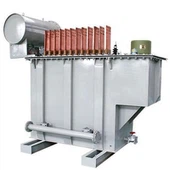
Transforamers are majorly the elements in Electrical engineering. These are the devices that changes the voltage level in Alternating current(AC) Electricity. This is a necessity for proper power distribution and use in multiple aspects. Among all kinds of transformers, step up transformer and step down transformer play important roles. They have different functions in electrical system. This article is on the principles, Construction, Applications, Advantages, and Disadvantages of Step-Up and Step-Down Transformer.

What is a Transformer?
A transformer is an electrical device that transfers electrical energy between two or more circuits through electromagnetic induction. A transformer is generally made up of the following three parts core, primary windings and secondary windings.
Core: The core is normally made from ferromagnetic material, which results in a strengthened magnetic field and greater efficiency.
Primary Winding: This is the coil connected to the input voltage source. This winding makes alternating current in it, and it makes a magnetic field around the core.
Secondary Winding: This coil is linked to the load. Magnetic field changes in the secondary winding produce voltage. The voltage produced can be either high or low compared to the primary voltage, depending on the number of turns in the windings.
if you want to know more about what is inside of a power transforemr, please click here!
Step-Up Transformers

Definition and Function
Step-up transformer is used to increase the voltage from the primary winding to the secondary winding. this kind of transformer has more turns on its secondary winding than on its primary winding, which leads to a higher voltage being produced.
Construction
The primary winding in a step-up transformer is less in number than the secondary. For example if the primary winding is 100 turns and the second 400 turns, the transformer wil stepup the voltage by a factor four. The primary (V1) and secondary voltage can be related to:

where N2 and N1 are the number of turns in the secondary and primary winding respectively.
Applications
Step up transformers are majorly used in High voltage transmission systems. When we make electricity at power plants, it's often at a low voltage. We need to step up the voltage to transmit this electricity over long distances without much loss due to resistance. This makes for more efficient power transmission, because when voltage gets higher, current goes down, lowering I²R losses (I stands for "current" and R for "resistance").
Common Applications Include:
Power Transmission: In electricity grids, step-up transformers are used in order to increase voltage for long distance electricity transmission.
Renewable Energy Systems: Wind and Solar power installation use step-up transformers to increase the voltage coming off of the turbines or solar panels for use on the grid.
Industrial Equipment: Some machinery requires high voltage to work, so they use step up transformer.
Advantages
Efficiency: We can increase voltage to transmit to make step up transformer to decrease energy loss
Distance: they can enable an impressive range of energy transfer without losing too much power.
Cost-Effective: Cutting down on the current by stepping up the voltage cuts off the need for bigger conductors and lessens infrastructure costs.
Disadvantages
Complexity: Step-up transformers could be hard to design and build.
Size and Weight: Higher voltage transformers might also be bigger and heavier so they need stronger supports.
Safety Risks: High voltage means there's a bigger chance of an electric shock, so we have to take safety rules very serious.
Step-Down Transformers

Definition and Function
A step-down transformer is different as it will decrease the voltage from the primary winding to the secondary winding. This uses more turns in the primary side than the secondary for a lower voltage.
Construction
Step Down Transformer: In Step down transformer, number of turns of the primary winding is more than that of the secondary winding. Let's say we have 400 turns on the primary and 100 turns on the secondary. This would step the voltage down by a factor of 4. The voltage relationship is similarly expressed as:

Applications
Step-down transformers are usually employed in all kinds of uses where low voltage is necessary for safe use. They are important parts of power distribution systems in residences and businesses.
Common Applications Include:
Residential Power Supply: Electricity from the grid gets stepped down to lower voltage for us (120V, 230V etc).
Charging Devices: A lot of laptop and smartphone chargers, plus chargers for other electronic devices, use step-down transformers to cut down on the high voltage to a safer level.
Industrial Machines: Equipment that requires less voltage to work can use step-down transformer.
Advantages
Safety: Using low voltages reduces the chances of people getting shocked, which makes them much safer for both places we live in and work in.
Simplicity: Step-down transformers are usually more simple than step-up transformers.
Compact Size: They can take up less space, so they can go in very tight places.
Disadvantages
Energy Losses: Step down transformers are efficient but they can experience some loss of energy if not designed well.
Limited Distance: They are not really good for long distance transmission as they only reduce volage and don't increase it.
Cost: There are some applications where it is cheaper to use many small Step-Down transformer instead of one.
Step-up and Step-down Transformers Comparison
Voltage Conversion
Step-up and step-down transformers the main visible difference between two is that they are used for changing the voltage. Step-up transformers change voltage up, Step-down transformers change voltage down So the two basic differences decide what they do and how they work.
Turns Ratio
The turns ratio is an important part of transformer design. Step up transformer -the secondary winding has more turns than the primary. Step down transformer -the secondary winding has less turns than the primary. This ratio can actually affect the results of transformer voltage transformation.

Efficiency and Losses
Both transformers are made so that they run as efficiently as possible, but they both will have losses. Step-up transformers perform best for long distance transmission, while step down transformers work well for safe and local delivery.
Applications and Use Cases
Step-Up: mainly used in higher voltage areas, such as high-voltage transmission, and some renewable energy and industrial machinery equipment that needs higher voltage.
Step-Down: Widespread application in residential power supply, consumer electronics, and all kinds of industries.
Conclusion
Step up and step down transformers are important equipment of the electrical power distribution system. They make it possible to send electricity for great lengths and make sure that the power gets there safely at levels that people can use. Knowing about these different types of transformers is important for anyone who studies electrical engineering, makes power, or gives out electricity.
Step-up transformers increase voltage to make it more efficient, but step-down transformers lower voltage to a safe level for homes and businesses to use. They both are important to electricity in today's world as modern electrical systems wouldn't be able to provide electricity to people all over the world without them.
Future Trends
Technology improves and transformers have new designs and efficiencies. New materials, like superconductors, and the mix of smart tech for watching and managing, seem to make both step-up and step-down transformers do more things and be more efficient later on. Plus, as the demand for renewable energy sources boosts, it will push the demand for both kinds of transformers to handle the integration of those energy sources into the existing power grids.
The article will give you a great view and knowledge of step up as well as Step down transformer, fulfilling the condition of detailed examination of the topic. If you want to explore any particular areas more or make any changes please let me know!
FAQ
Q: 1. How soon can you delivery the transformer?
A: It depends on the quantity and capacity of the transformer, normally within one month since the date drawing confirmed by buyer.
Q: 2. How long can you provide the quality warranty?
A: 24 months since the date transformer operated.
Q: 3. What payment method do you accept?
A: T/T (wire transfer) preferred, L/C both accepted.