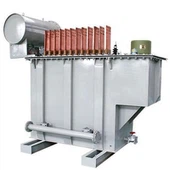
Power transformers are electrical equipment manufactured based on the principle of electromagnetic induction, therefore, power transformers should have at least the ability to efficiently utilize the iron core and winding of electromagnetic induction.
The main parts of a power transformer are the iron core, winding, insulation, casing, and necessary components etc. Due to differences in capacity and voltage, the structure of the iron core, winding, insulation, casing, and necessary components of power transformers can also be different.
Iron Core
Transformers can transform different voltages by inducing changes in the magnetic flux within the iron core over time in windings of different turns different voltages should be generated (or different voltages can be obtained by tapping different turns in one winding).

Grain oriented electrical steel strip
In order to induce a voltage proportional to the number of turns in different windings, the magnetic flux of the two windings needs to be equal. This requires a core made of a material with high magnetic permeability inside the windings, so as to make all the magnetic flux in the core interlock with the two windings and minimize the magnetic flux interlock with only one winding.
Materials with different magnetic permeabilities require different ampere turns to generate the same magnitude of magnetic flux. That is to say, materials with higher magnetic permeability require fewer ampere turns to generate the same magnetic flux, while materials with lower magnetic permeability require more ampere turns.
Due to the high magnetic permeability of ferromagnetic materials, in the early stages of transformer development, ordinary iron sheets were used as the core material, and later hot-rolled magnetic steel sheets were developed for transformer core manufacturing. In the 1940s, metallurgical enterprises developed cold-rolled oriented magnetic steel sheets, gradually replacing hot-rolled magnetic steel sheets. After the 1970s, high permeability magnetic steel sheets (Hi-B) were developed, which have lower unit losses and excitation ampere turns than ordinary grain oriented magnetic steel sheets. In the 1980s, magnetic steel sheets with lower losses were developed by refining magnetic domains through laser irradiation or mechanical indentation methods.
The main function of magnetic steel sheets are the loss per unit mass and the magnetic permeability of the material. Compared with hot-rolled magnetic steel sheets in the past, the losses of cold rolled grain oriented magnetic steel sheet has been greatly reduced. So currently, various grades of grain oriented magnetic steel sheets are used as iron core materials in power transformers. Only in some distribution transformers production, amorphous alloys are used as the magnetic material for the iron core to reduce no-load losses.
The characteristics and applications of various soft magnetic materials are shown in below table, which shows that the oriented electrical steel strip has low iron loss, high saturated magnetic flux density and relatively lower price, therefore it is widely used in power transformers.
| Materials | Applicable frequency | saturation induction/T | Main Purpose |
| Oriented electrical steel strip | 50~Hundreds Hz | 2.03 | electrical transformer |
| Non oriented electrical steel strip | 50~Hundreds Hz | 2.0~2.18 | Electric motor, small transformer, shell reactor |
| Permendur alloy | 50~Hundreds Hz | 2.35 | electronic device |
| Pomo alloy | 50~1000Hz | 1.6 | Communication transformer, mutual inductance, magnetic head |
| Iron based amorphous alloy | 50~HundredskHz | 1.6 | Electronic components,mutual inductance,small transformer |
| Soft magnetic ferrite | 16kHz~1MHz | 0.51 | High frequency transformer, inductor coil |
| Squeezed iron powder magnetic core | 10kHz~100MHz | 0.6-1.0 | Electronic components |