Cloud Managed Data Center Services: The Role of Reliable Transformer Solutions
As businesses move more applications, data, and workloads to the cloud, the demand for reliable data center infrastructure continues to grow. Cloud platforms depend on data centers that can operate around the clock, support increasing computing loads, and maintain stable power supplies. This is where cloud managed data center services and reliable electrical distribution systems come together.
While cloud management focuses on monitoring, security, resource allocation, and operational efficiency, the physical data center must have a dependable power infrastructure to support these services. Transformers, switchgear, uninterruptible power supplies (UPS), and power distribution units (PDUs) all play important roles in maintaining continuous operation.
For data center developers, electrical contractors, and facility managers, understanding this relationship is essential when planning new facilities or upgrading existing infrastructure.
What Are Cloud Managed Data Center Services?
Cloud managed data center services refer to the management and optimization of cloud-based IT infrastructure and the data center resources that support it. Depending on the service model, these services may include cloud infrastructure management, server monitoring, network administration, cybersecurity, backup and recovery, workload optimization, and performance monitoring.
Many organizations use managed services to reduce the burden on internal IT teams while improving system availability and operational flexibility. Instead of handling every technical task themselves, businesses can rely on specialized service providers to manage cloud environments and associated infrastructure.
However, cloud services are only as dependable as the facilities supporting them. A cloud platform may have sophisticated software and automated failover systems, but it still needs stable electrical power to keep servers, storage equipment, cooling systems, and networking hardware running.
This makes power infrastructure a fundamental consideration in data center design.
Why Reliable Power Matters for Cloud Data Centers
Cloud computing environments often serve multiple customers and applications simultaneously. A power interruption can affect virtual machines, databases, business applications, and online services. Even a short disruption may cause operational problems if the facility lacks suitable backup and recovery arrangements.
Several factors make reliable power infrastructure especially important.
Continuous operation: Data centers typically run 24 hours a day. Their electrical systems must support sustained loads rather than occasional peak demand.
Increasing power density: AI workloads, cloud computing, and high-performance servers are increasing the power requirements of many facilities. Electrical infrastructure must be designed for both current demand and planned expansion.
Cooling requirements: Servers generate significant heat, so cooling systems are essential to maintaining safe operating temperatures. The power system must support IT equipment as well as chillers, pumps, fans, and other auxiliary loads.
Power quality: Voltage fluctuations, electrical disturbances, and improper system coordination can affect sensitive electronic equipment.
Appropriate transformer selection and a well-designed distribution system help support stable operation.
For these reasons, power planning should be considered alongside IT capacity, cloud architecture, and facility management from the earliest stages of a data center project.
The Role of Transformers in Data Center Power Distribution
Transformers are a key part of the electrical infrastructure supporting cloud managed data center services. They adjust voltage levels between the utility supply and the facility's internal electrical distribution network.
A typical power path may include the utility grid, medium-voltage switchgear, a main transformer, low-voltage switchgear, UPS equipment, and PDUs that distribute power to IT loads. The actual arrangement varies with the facility's voltage levels, capacity, redundancy strategy, and local electrical standards.
The transformer selected for a project must match the electrical design and operating conditions.
Dry-Type Transformers for Indoor Data Centers
Dry-type transformers are often considered for indoor electrical rooms and facilities where avoiding liquid insulation is a priority. They use air and solid insulation systems rather than insulating oil, making them suitable for many indoor applications when appropriately specified.
Common selection considerations include rated capacity, primary and secondary voltage, insulation class, temperature rise, cooling method, enclosure protection, and installation environment.
For facilities with strict fire-safety requirements or limited space, a dry-type transformer may be an attractive option. Cast-resin designs can also be considered where environmental conditions and project specifications support their use.
Oil-Immersed Transformers for Main Power Supply
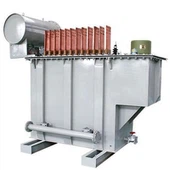
Oil-immersed transformers are widely used in utility and medium-voltage power distribution applications. The insulating liquid provides electrical insulation and helps transfer heat away from the windings and core.
Depending on the project, these transformers may be installed outdoors or in designated electrical areas with appropriate containment, clearances, and fire protection.
For large data center campuses, oil-immersed transformers can be considered for utility interconnection, incoming power transformation, or other high-capacity applications. Their suitability depends on the installation arrangement, applicable regulations, maintenance requirements, and the project's safety strategy.
How to Select the Right Data Center Transformer
Transformer capacity should be calculated from the expected electrical load, including IT equipment, cooling systems, lighting, and other facility services. Engineers should also account for load growth, power factor, harmonic conditions, redundancy requirements, and operating scenarios.
| Selection factor | Why it matters |
|---|---|
| Rated capacity (kVA/MVA) | Supports the planned electrical load and future expansion |
| Primary and secondary voltage | Matches the utility connection and downstream distribution system |
| Cooling method | Helps maintain acceptable operating temperatures |
| Efficiency | Reduces electrical losses and associated heat generation |
| Impedance | Influences fault current and voltage regulation |
| Harmonic performance | Helps address nonlinear loads from UPS systems and electronic equipment |
| Redundancy requirements | Supports the facility's selected availability strategy |
| Applicable standards | Ensures compliance with project and regional requirements |
There is no single transformer specification suitable for every cloud data center. The final design should be based on a detailed load study, electrical calculations, and the facility's operational requirements.
Integrating Transformers with Data Center Redundancy
High-availability data centers often use redundant electrical paths to reduce the impact of equipment failures or scheduled maintenance.
Depending on the required availability level, a facility may use N+1 equipment redundancy, dual power paths, or other engineered configurations.
Transformers must be considered as part of this overall architecture.
For example, a facility with two independent power paths may require separately designed transformer and switchgear arrangements. Engineers must evaluate whether each path can support its intended load and how the system behaves when a transformer or other major component is unavailable.
Redundancy does not automatically guarantee uninterrupted operation. Protection coordination, switching procedures, UPS capacity, generator integration, maintenance planning, and commissioning all contribute to the actual resilience of the system.
When designing power infrastructure for cloud managed data center services, project teams should evaluate the complete electrical system rather than treating the transformer as an isolated component.
Energy Efficiency and Long-Term Operating Costs
Electricity is one of the largest operating expenses for many data centers.  Transformer losses contribute to energy consumption, and the resulting heat may also increase cooling demand.
Choosing an appropriately sized, high-efficiency transformer can help reduce these losses over the equipment's operating life. However, efficiency should be assessed alongside purchase cost, expected loading, cooling requirements, maintenance needs, and projected load growth.
Oversizing a transformer without a clear engineering reason may increase capital expenditure, while undersizing can restrict expansion and cause operational problems. A properly engineered solution balances current requirements with future demand.
Facility operators should also monitor transformer temperature, loading, electrical connections, insulation condition, and other indicators relevant to the equipment design. A planned maintenance program helps identify developing issues before they affect the wider electrical system.
Planning Electrical Infrastructure for Future Cloud Growth
Cloud services are changing rapidly, and data center power requirements continue to evolve. AI computing, high-density server racks, liquid cooling, and large-scale cloud deployments can all influence the electrical design.
Developers should therefore consider scalability from the beginning. Modular electrical rooms, appropriately sized distribution equipment, space for additional transformers, and a clear expansion strategy can make future upgrades easier.
Close coordination between IT teams, cloud service providers, electrical consultants, EPC contractors, and transformer manufacturers is particularly important. The power infrastructure must reflect the actual load profile and the intended growth plan, not simply the initial server count.
Yawei Transformer: Power Solutions for Data Center Projects
Jiangsu Yawei Transformer Co., Ltd., a subsidiary of Yawei Group, was established in 1993 and has more than 30 years of transformer manufacturing experience. The company provides transformer solutions for power distribution and industrial applications, including dry-type and oil-immersed transformer designs.
For data center developers, electrical contractors, and engineering procurement teams, transformer selection involves more than rated capacity alone. Voltage requirements, efficiency, cooling, installation conditions, protection arrangements, and future expansion all need to be considered.
Yawei works with project requirements to identify suitable transformer configurations for different power distribution applications. Final specifications should be confirmed through engineering review to ensure compatibility with the facility's electrical design and applicable standards.
If you are planning a new data center, expanding cloud infrastructure, or upgrading an existing electrical distribution system, contact Yawei Transformer to discuss your project requirements and request a customized quotation.
Conclusion
Cloud managed data center services depend on more than software, servers, and network connectivity. Behind every reliable cloud platform is a physical infrastructure that must deliver stable power, support cooling, and accommodate changing workloads.
Transformers form an essential link between incoming electrical power and the systems that keep data centers operating. By selecting suitable transformer technology, planning redundancy carefully, and considering long-term efficiency, project teams can build a stronger foundation for reliable cloud services.
For data center owners, consultants, and EPC contractors, early coordination between IT requirements and electrical engineering is a practical step toward safer, more efficient, and more scalable facilities.
Q: How soon can you delivery the transformer?
A: It depends on the quantity and capacity of the transformer, normally within one month since the date drawing confirmed by buyer.
Q: How long can you provide the quality warranty?
A: 24 months since the date transformer operated.
Q: What payment method do you accept?
A: T/T (wire transfer) preferred, L/C both accepted.