

Power Factor of a Transformer: Definition, Calculation, Influencing Factors, and Improvement
Power factor is an important parameter in electrical power systems because it affects how efficiently electrical power is used and distributed. For transformers, understanding power factor helps engineers evaluate electrical loads, reduce unnecessary current, improve system efficiency, and select suitable equipment for industrial and commercial applications.
Although transformers transfer electrical energy from one voltage level to another, they do not consume real power in the same way as resistive loads. They require reactive power to establish the magnetic field inside their cores. This means the power factor of a transformer depends on its operating conditions, connected loads, and magnetic characteristics.
For manufacturers, engineers, and electrical contractors, understanding transformer power factor is essential for designing reliable power distribution systems.

What Is Power Factor?
Power factor is the ratio of real power to apparent power in an AC electrical system. It indicates how effectively electrical power is converted into useful work.
Power factor is expressed as a decimal between 0 and 1, or sometimes as a percentage.
The basic formula is:
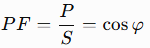
Where:
PF: Power factor
P: Real power, measured in kilowatts (kW)
S: Apparent power, measured in kilovolt-amperes (kVA)
φ: Phase angle between voltage and current
A power factor close to 1 indicates that most of the apparent power is being converted into useful real power. A lower power factor means the system requires more current to deliver the same amount of real power.
For example, a system operating at 100 kW with a power factor of 0.8 requires 125 kVA of apparent power.
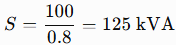
If the power factor improves to 0.95, the required apparent power decreases to approximately 105.3 kVA.
This can reduce current demand and improve the utilization of electrical equipment.
What Is the Power Factor of a Transformer?
The power factor of a transformer is influenced by two main operating conditions: its no-load condition and its loaded condition.
When a transformer is energized but has no connected load, it still draws a small amount of current from the power supply. This current is called no-load current or excitation current. It consists mainly of a magnetizing component and a smaller active component associated with core losses.
Because the magnetizing current is largely reactive, the transformer's no-load power factor is usually relatively low.
When a load is connected, the transformer supplies both real and reactive power according to the characteristics of the load. Its overall operating power factor changes accordingly.
It is important to understand that a transformer does not have one fixed power factor rating in the same way it has a rated voltage, frequency, or kVA capacity. Its power factor depends on the connected electrical system and operating conditions.
Factors Affecting Transformer Power Factor
Several factors influence the power factor of a transformer during operation.
Load Characteristics
The connected load is one of the most important factors. Resistive loads, such as electric heating equipment, generally operate at a power factor close to 1. Inductive loads, including motors, pumps, compressors, and industrial machinery, typically consume reactive power and have a lagging power factor.
When a transformer supplies many inductive loads, the overall power factor of the system may decrease.
Transformer Loading Rate
Transformer loading also affects its operating characteristics.
At very light loads, the magnetizing current and core losses represent a relatively large proportion of the total power consumption.
Consequently, the no-load component has a greater influence on the overall power factor.
As the load increases, the load current becomes more significant, and the power factor increasingly depends on the connected equipment.
However, operating a transformer near its rated capacity does not automatically guarantee a high power factor.
Core Material and Magnetic Design
The transformer's core material, magnetic flux density, and core construction influence magnetizing current and iron losses.
High-quality silicon steel and optimized core designs can help reduce no-load losses and improve transformer performance.
Manufacturing precision also matters. Proper core assembly and suitable magnetic circuit design help ensure stable operation.
Harmonic Distortion
Modern electrical equipment, including variable frequency drives, rectifiers, UPS systems, and switching power supplies, can introduce harmonic currents into electrical networks.
These harmonics may reduce the true power factor, increase transformer heating, and create additional losses.
In systems with significant nonlinear loads, engineers should consider both displacement power factor and total power factor when evaluating performance.
How to Calculate Transformer Power Factor
The power factor calculation is based on real power and apparent power.
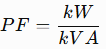
For example, consider a three-phase transformer supplying an industrial facility with the following operating parameters:
|
Parameter |
Value |
|---|---|
|
Real power |
800 kW |
|
Apparent power |
1,000 kVA |
|
Rated voltage |
400 V |
|
System frequency |
50 Hz |
The power factor is:
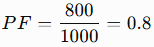
Therefore, the transformer system operates at a power factor of 0.8.
For a balanced three-phase system, apparent power can also be calculated using:

Where V is line-to-line voltage and I is line current.
Engineers can use these formulas together to evaluate transformer loading, current demand, and electrical system performance.
Why Is Power Factor Important for Transformers?
Power factor has a direct influence on the performance and capacity utilization of transformer-based electrical systems.
Improved transformer capacity utilization: A low power factor means more apparent power is required to supply the same real power. This uses a larger portion of the transformer's kVA capacity, potentially limiting the amount of additional equipment that can be connected.
Reduced current and electrical losses: For a given real power and voltage, improving power factor reduces the current required. Since copper losses are proportional to the square of current, lower current can reduce losses in transformer windings and connected cables.
Better voltage regulation: Excessive reactive current increases voltage drops across system impedance. Improving power factor can help reduce these drops and maintain more stable voltage levels.
Lower electricity costs: Some industrial and commercial electricity tariffs include penalties or additional charges for low power factor or excessive reactive power demand. Power factor correction can help reduce these costs, depending on the utility's billing structure.
How to Improve Power Factor in Transformer Systems
Power factor correction is commonly used in industrial facilities and commercial buildings where inductive loads create significant reactive power demand.
Capacitor banks are among the most widely used solutions. They supply reactive power locally, reducing the amount of reactive power that must be drawn from the electrical network.
For facilities with changing loads, automatic power factor correction (APFC) systems can switch capacitor stages in and out according to real-time reactive power demand.
Other solutions include installing appropriately sized synchronous condensers or using active power factor correction equipment where harmonic distortion and rapidly changing loads require more advanced control.
However, capacitor banks should be properly designed. In systems with significant harmonics, engineers may need detuned reactors or harmonic filters to prevent resonance and excessive harmonic currents.
It is also important to remember that power factor correction does not increase the transformer's rated kVA capacity. Instead, it reduces the apparent power demand associated with a given real power load, potentially freeing up usable capacity.
How Transformer Design Influences Electrical Efficiency
Although the connected load largely determines the operating power factor, transformer design still plays an important role in overall electrical system performance.
A well-designed transformer should minimize core losses, winding losses, and unnecessary temperature rise while maintaining reliable voltage regulation.
At Yawei Transformer, transformer manufacturing focuses on electrical performance, thermal management, and long-term operating reliability. Different applications require different transformer configurations, voltage levels, cooling methods, and capacity ratings.
Jiangsu Yawei Transformer Co., Ltd., established in 1993, has more than 30 years of experience in transformer manufacturing. Its product range includes oil-immersed transformers, dry-type transformers, distribution transformers, power transformers, and customized transformer solutions for industrial facilities, utility networks, renewable energy projects, and other applications.
When selecting a transformer, buyers should evaluate rated capacity, voltage ratio, impedance, losses, temperature rise, harmonic requirements, and expected load power factor rather than focusing on kVA capacity alone.
Conclusion
Power factor is an important consideration in transformer applications because it affects current demand, electrical losses, voltage regulation, and the utilization of installed equipment. Although the transformer itself does not determine the entire system power factor, its magnetic characteristics and operating conditions contribute to overall electrical performance.
By understanding power factor, evaluating connected loads, and applying appropriate correction methods, engineers can improve electrical system efficiency and make better use of transformer capacity.
Choosing a transformer with suitable electrical characteristics and reliable manufacturing quality is equally important for long-term operation. Contact Yawei Transformer to discuss transformer specifications and customized solutions for your power distribution project.
FAQ
Q: How soon can you delivery the transformer?
A: It depends on the quantity and capacity of the transformer, normally within one month since the date drawing confirmed by buyer.
Q: How long can you provide the quality warranty?
A: 24 months since the date transformer operated.
Q: What payment method do you accept?
A: T/T (wire transfer) preferred, L/C both accepted.


