

what is a transformer made of
An electrical transformer is typically made of a magnetic core, copper or aluminum windings, and insulation that keeps energized parts separated. Power and distribution transformers also need structural supports, connections, and cooling arrangements; liquid-filled designs include insulating fluid and a tank. This guide explains the main materials, what each component does, and why construction differs between transformer types.

What materials are used to make a transformer?
Most utility-frequency transformers combine electrical steel for the core, copper or aluminum for the windings, and insulating materials such as paper, pressboard, resin, or specialized coatings. Liquid-filled transformers add dielectric fluid, while dry-type transformers use solid insulation and air rather than a liquid cooling medium. The exact combination depends on the approved design and application.
The distinction between materials and components is useful: copper is a material; a winding is a component made from a conductor and its insulation. Here is a practical overview of common transformer parts.
| Component | Typical materials | Main purpose |
|---|---|---|
| Magnetic core | Laminated electrical steel; alternative magnetic materials in some designs | Guides magnetic flux |
| Windings | Insulated copper or aluminum conductors | Carry input and output current |
| Solid insulation | Paper, pressboard, polymers, or resin | Separates energized parts |
| Insulating liquid, where fitted | Mineral oil or an approved alternative fluid | Insulates and transfers heat |
| Tank or enclosure | Commonly steel | Contains or protects the assembly |
| Bushings and terminals | Conductors combined with insulating materials | Provide external electrical connections |
These components work as a coordinated assembly, not as interchangeable raw materials. For example, changing a conductor or insulation system can affect the physical arrangement and thermal design, so a material substitution requires engineering review.
The magnetic core: a controlled path for flux
The core provides a path for the magnetic flux linking the windings. Many power and distribution transformers use grain-oriented electrical steel, an iron-based material selected for its magnetic properties. Rather than being one solid metal block, the core consists of thin sheets or strips assembled into the required shape.
Why the core is laminated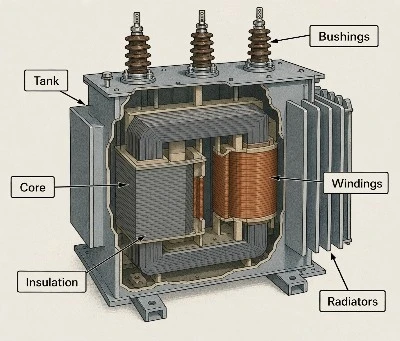
A changing magnetic field can induce circulating currents inside conductive core material. These eddy currents waste energy as heat. Dividing the core into thin, insulated laminations restricts those current paths and reduces the associated losses; the layered construction therefore serves an electrical purpose, not just a manufacturing one.
The steel grade and core arrangement also matter. A transformer core is an engineered magnetic circuit, so its material cannot be judged solely by weight or appearance. Manufacturers select the core material and construction together to meet the equipment's operating requirements.
Alternative core materials
Electrical steel is not universal. Some distribution transformers use amorphous alloy cores when low no-load losses are a design priority. High-frequency transformers in electronic equipment may use ferrite, whose high electrical resistance helps limit eddy-current losses at higher frequencies.
That difference explains why a small electronic transformer and a utility transformer need not contain the same core material. Frequency and application influence the choice; size alone does not identify what is inside.
The windings: copper or aluminum conductors
Windings are coils of insulated conductor. The primary winding receives electrical input, while the secondary winding supplies the connected load. Copper and aluminum are both used in commercial transformer construction, including dry-type designs.
Copper has higher electrical conductivity, while aluminum is lighter. However, conductor material alone does not determine whether a transformer is suitable or efficient. The conductor dimensions, winding arrangement, insulation, cooling system, and overall design must be considered together.
Windings also do not always resemble ordinary round wire. Depending on the design, manufacturers use round, flat, band, or foil conductors. These forms allow the winding geometry to suit the electrical and manufacturing requirements.
A useful purchasing question is therefore not simply "Does it contain copper?" Ask what conductor material the design specifies, what ratings the complete transformer meets, and whether its documented construction matches the application. Schneider Electric, for example, identifies both aluminum and copper as possible winding materials in its transformer range.

Insulation: the separation that makes operation possible
Insulation separates winding turns, windings from one another, and energized conductors from grounded structures. Without the correct separation, current could follow unintended paths instead of remaining within the designed circuit. Insulation must withstand electrical stress while also tolerating the thermal and mechanical conditions inside the transformer.
Common solid insulation materials include:
Insulating paper: Used around conductors and in winding insulation systems.
Pressboard: Used for formed insulating barriers, spacers, and structural insulation.
Polymers and flexible laminates: Used where the design needs particular electrical or mechanical properties.
Resin systems: Used to encapsulate or cast windings in certain dry-type transformers.
The important point is that insulation is a system rather than one wrapping material. Solid insulation, clearances, and any dielectric fluid must work together. Moisture, contamination, and overheating can undermine that system, which is why insulation condition receives close attention during transformer assessment.

How do the components of a transformer work together?
A transformer transfers energy through electromagnetic induction: an alternating input produces changing magnetic flux, which links the windings and induces voltage in the output winding. The core guides that flux, the conductors carry current, and the insulation maintains electrical separation. Cooling and structural components support continued operation under the conditions for which the transformer was designed.
For a basic two-winding transformer, the sequence is:
Input voltage energizes the primary winding. The resulting magnetic action establishes changing flux in the core.
The flux links the secondary winding. A voltage is induced across that winding.
The turns ratio establishes the approximate voltage ratio. More secondary turns produce a higher voltage; fewer produce a lower voltage.
The cooling arrangement removes operating heat. Air or insulating liquid carries heat away from the active assembly.
As a simplified illustration, a secondary with half as many turns as the primary produces approximately half the primary voltage under ideal conditions. This explains voltage transformation, but it is not a complete sizing rule: current capacity, losses, insulation requirements, and temperature limits still matter.
How do liquid-filled and dry-type transformers differ?
Liquid-filled transformers immerse their active components in dielectric fluid that provides insulation and cooling. Dry-type transformers do not use liquid for those functions; instead, their construction relies on dry insulation systems and heat transfer to surrounding air. Both types still contain windings and a magnetic assembly, but their insulation and cooling arrangements differ substantially.
Liquid-filled construction
Mineral oil is a common transformer fluid. It electrically insulates internal components and carries heat from the core and windings toward cooling surfaces. Other fluids are also available, including natural esters formulated from vegetable oils.
Fluid selection is not simply a choice between two interchangeable liquids. The transformer's design, fluid condition, handling requirements, and compatibility must be considered.

The surrounding tank contains the liquid and internal assembly. Depending on the cooling arrangement, external radiators, fans, or other equipment help reject heat. A conservator, where fitted, provides space for changes in insulating-fluid volume as temperature changes.
Dry-type construction
Dry-type does not mean uninsulated. These transformers use dry insulating systems, and some encapsulated designs surround the windings with solid insulating compounds. Ventilated units instead allow air circulation around the assembly.
Cast-resin construction is one specific approach. Resin is cast around prepared windings under vacuum and then cured to form solid coils. Other dry-type constructions use different insulation processes, so "dry-type" should not be treated as a synonym for "cast resin."
External power transformer components and accessories
The visible equipment around a large transformer supports connection, voltage adjustment, cooling, monitoring, and protection. These transformer accessories may look secondary to the core and coils, but they perform essential operating functions. The exact package varies with transformer design and service requirements.
Bushings and tap changers
Bushings provide insulated paths for conductors to pass through the transformer's grounded enclosure. They combine current-carrying and insulating elements, allowing external circuits to connect to internal windings without creating an unintended connection to the tank.
Tap changers alter the effective winding turns ratio to adjust voltage. A de-energized  tap changer must be adjusted with the transformer turned off, unlike an on-load tap changer designed for adjustment during operation. These are different equipment arrangements, not alternative operating methods for the same switch.
Cooling, monitoring, and fluid-management equipment
Depending on the transformer, supporting equipment can include:
Radiators and fans: Help remove heat from the transformer.
Temperature instruments: Provide information about operating temperature.
Liquid-level indicators: Show insulating-fluid level.
Pressure-relief devices: Provide a pressure-release function.
Breathers and preservation equipment: Support the insulating-liquid preservation arrangement.
Valves: Provide designated fluid-handling points.
Identifying parts and understanding technical documents
When reviewing transformer parts, start with the equipment documentation rather than guessing from appearance. Manufacturers provide selection tools and technical information because components such as bushings and tap changers require configuration-specific selection. A familiar-looking component is not enough to establish compatibility.
A practical document-review checklist is:
Establish whether the transformer is liquid-filled or dry-type.
Identify the component's function before comparing materials.
Record the manufacturer's part identification and applicable ratings.
Check the specified insulation, connections, and mounting arrangement.
Confirm selection against the transformer's approved documentation.
conclusion
The clearest answer is that a transformer combines magnetic material, conductive windings, and an engineered insulation system. Larger units add structures and accessories that manage connections, heat, fluid, voltage adjustment, and monitoring. Understanding those functions is more useful than memorizing a materials list: it explains why two transformers can do similar jobs while containing different materials and component arrangements.
FAQ
Q: How soon can you delivery the transformer?
A: It depends on the quantity and capacity of the transformer, normally within one month since the date drawing confirmed by buyer.
Q: How long can you provide the quality warranty?
A: 24 months since the date transformer operated.
Q: What payment method do you accept?
A: T/T (wire transfer) preferred, L/C both accepted.


