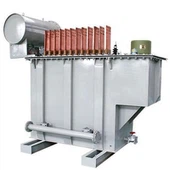
Understanding Three-Phase Transformer Connections
Three-phase transformer connections are at the heart of pretty much every modern power system. They're what make it possible to step voltages up or down efficiently while keeping everything balanced across industrial plants, cities, and even our homes. The way you connect the primary and secondary windings-whether in star or delta-has a huge impact on voltages, currents, grounding, harmonics, and how reliably the whole thing runs. Get it right, and your system stays smooth. Get it wrong, and you're looking at imbalances, extra losses, or even equipment damage.

(Click the image to learn more.)
There are two main ways to connect the windings: star (Y or wye) and delta (Δ).
In a star connection, the three windings meet at a common neutral point. Line voltage is √3 times the phase voltage, but line current equals phase current. This gives you a handy neutral for grounding and makes it easier to supply both single-phase and three-phase loads. Delta, on the other hand, connects the windings in a closed triangle. Here, line voltage equals phase voltage, but line current is √3 times higher. Delta is great at dealing with unbalanced loads and naturally circulates third harmonics inside the loop so they don't escape into the lines.
From these two building blocks, we get the four main three-phase transformer connections:
Star-Star (Y-Y) Both sides are star-connected. You get neutrals on both primary and secondary, which is useful for high-voltage work because each winding only sees line voltage divided by √3. That means cheaper insulation. The downside? It doesn't like unbalanced loads-neutral can shift and you can get voltage distortion. Third harmonics can also cause trouble if you don't handle grounding carefully. It works best when loads are nicely balanced.
Delta-Delta (Δ-Δ) Both sides in delta. This setup is tough and forgiving with unbalanced loads. If one phase goes down, you can even run in open-delta at about 58% capacity. Harmonics stay contained. The catch is that every winding sees full line voltage, so insulation costs more and there's no natural neutral.
Star-Delta (Y-Δ) Star on the primary, delta on the secondary. Very common for step-down transformers. You can ground the high-voltage side nicely, and the delta helps trap harmonics. There's a 30° phase shift to keep in mind though.
Delta-Star (Δ-Y) This is probably the most popular one you'll see in distribution networks. Delta on the high-voltage side, star with neutral on the low-voltage side. It gives you that all-important neutral for homes and small loads while the delta primary handles harmonics and imbalance really well. Again, expect that 30° phase shift.

These phase shifts aren't just technical details-they matter a lot when you're paralleling transformers. That's why engineers use vector groups like Dyn11, Yd1, etc. The code tells you exactly what's connected where and by how many degrees the secondary lags or leads (clock notation makes it easy to remember).
Besides the standard four, there are a couple of useful variations. Open-delta (V-V) lets you run three-phase power with just two transformers-handy for temporary setups or light loads. Zig-zag connections are excellent when you need really good grounding or extra harmonic filtering.
Choosing the right three-phase transformer connections isn't a one-size-fits-all thing.
It depends on your voltage level, how balanced (or unbalanced) your loads are, whether you need a neutral, and how much harmonic pollution you're dealing with. In practice, Dyn11 (delta primary, star secondary with neutral) has become the go-to for most distribution transformers because it just works well for real-world conditions.
Harmonics are a big headache these days with all the electronics and VFDs around. That's another reason delta windings are so useful-they trap those triple-n harmonics before they cause problems further down the line.
When installing or maintaining these transformers, always double-check polarity, vector group, and turns ratio. A mismatch can cause serious circulating currents and overheating. Regular maintenance-insulation testing, oil checks, thermal imaging-goes a long way in catching issues early.
You'll find these connections everywhere: stepping up voltage at power plants, stepping it down at substations, running heavy motors in factories, and integrating solar and wind farms into the grid. As we move toward smarter, greener power systems, getting these connections right becomes even more important.

At the end of the day, three-phase transformer connections might seem like a dry technical topic, but they're genuinely fascinating once you see how they quietly keep our electrified world running smoothly. Whether you're an engineer designing a new substation or just someone who wants to understand how power gets to your socket, knowing the strengths and quirks of Y-Y, Δ-Δ, Y-Δ, and Δ-Y setups gives you a much better grasp of the whole system.