

Understanding Transformer Bushings: What They Really Do
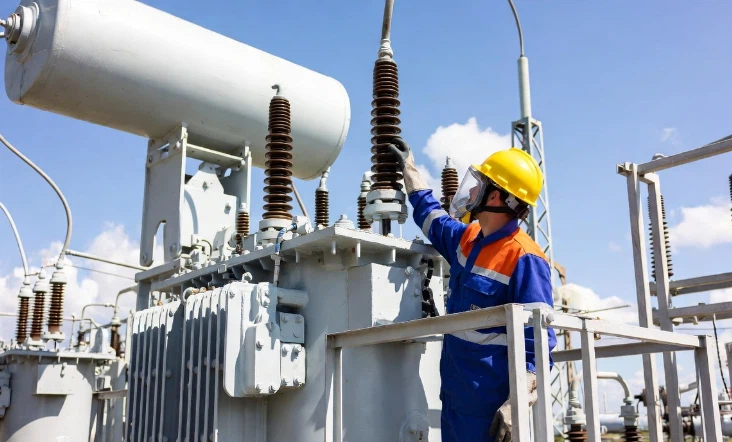
Next time you walk past those big gray transformers on the utility poles in your neighborhood, take a closer look at the top. You'll see those ribbed, cone-shaped things that look like giant porcelain hats stacked on top. They might seem like just another odd-looking part, but they're actually one of the most important safety features in the whole power system.
Electricity is always trying to find the fastest way to the ground, and if a live wire ever touched the metal casing without proper protection, things would go very wrong very quickly - think sparks, explosions, the works. That's exactly why transformer bushings exist. In simple terms, they act like a heavily insulated passageway that lets high-voltage electricity safely enter and exit the transformer tank without turning the entire metal box into a live hazard.
Think of it like this: without a bushing, running a live wire straight through a hole in a metal box would be like threading a cable through a sharp metal edge without any protection - the whole thing becomes dangerous. A bushing is basically a high-tech, super-insulated tunnel that keeps the power where it belongs: inside the conductor, not leaking out to the tank or the ground.
What is inside of the transformer?click here!
The "Grommet" Trick That Keeps Electricity in Check
At its core, a bushing works a lot like the rubber grommet you see protecting wires passing through a desk or panel. Inside the bushing you have the actual metal conductor carrying the current. Wrapped around it is a strong insulating body - usually made of porcelain or tough polymer materials - that stops the electricity from jumping sideways.
The whole design is built around one simple but critical idea: electricity wants a shortcut, and the metal tank is a very tempting path. The bushing's job is to block that shortcut completely and force the power to keep flowing safely down the line to your home.
Top Transformer Bushing Brands in China (2026 Market Overview)
| Category | Brand / Company Name | Key Strengths & Features | Best Suitable Applications | Market Position & Remarks |
|---|---|---|---|---|
| Major Group / Transformer Manufacturers | TBEA (Tebian Electric Apparatus) | Leading in UHV DC bushings, strong R&D, high reliability | UHV, 110kV+ high voltage projects | National champion, strong export capability |
| Major Group / Transformer Manufacturers | XD Group (Xi'an XD) | Excellent in UHV AC bushings, full industry chain support | Ultra/UHV AC & DC projects | Key supplier to State Grid |
| Major Group / Transformer Manufacturers | Baoding Tianwei (BBW) | Superior seismic & pollution performance, nuclear power experience | High voltage, nuclear & major projects | Strong technical capability |
| Professional Bushing Manufacturers | Nanjing Electric (NJREC) | Wide product range, good balance of porcelain & composite | High voltage, export projects | Well-known exporter, high cost-performance |
| Professional Bushing Manufacturers | Dalian Electric Porcelain | Long history, excellent durability of porcelain bushings | Medium to high voltage porcelain bushings | Traditional leader in porcelain bushings |
| Professional Bushing Manufacturers | SUVELL (Wenzhou Shuowei Electric) | Specialist in low voltage & secondary bushings, advanced epoxy/ceramic tech, fast delivery | Distribution transformers, LV & switchgear | Top brand in low voltage segment |
| Professional Bushing Manufacturers | Nanci Group (南瓷电气) | Strong in composite wall bushings, lightweight & impact resistant | Southern Grid, distribution & retrofit projects | Popular in Southern China market |
| Professional Bushing Manufacturers | Jiangsu Shuangbao / Yangzhou Shuangbao | Covers wide voltage range, stable quality | Medium & low voltage distribution | Good value for money, flexible customization |
| Professional Bushing Manufacturers | SHEMAR (神马电力) | Leading in composite explosion-proof bushings | High reliability & explosion-proof projects | Innovative composite bushing specialist |
| Other Notable Brands | Xingxi Power, Suzhou Electric Porcelain, Pingxiang Nankeng | Competitive pricing in medium/low voltage porcelain bushings | LV/MV retrofit & industrial distribution | Reliable regional suppliers |
Click here to connact with us to know more about the bushing which yawei to choose!
Why Bushings Look Like Accordions
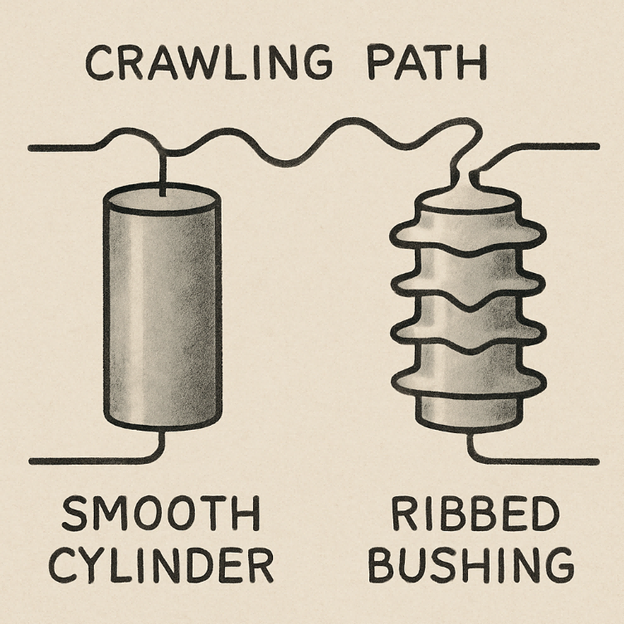
If you've ever noticed, these bushings are never smooth. They have those weird stacked ridges called "sheds." There's a good reason for that. If the surface was perfectly flat, rainwater would just run down in one continuous sheet, creating a perfect path for electricity to crawl along the outside and cause trouble.
Those accordion-like sheds do three important things:
They make the path much longer, so electricity has a harder time jumping across.
They break up water flow - rain drips off the edges instead of forming a conductive film.
They keep the undersides of the ridges relatively dry even in wet weather.
This clever shape is especially important on high-voltage bushings, which need much taller stacks of sheds compared to low-voltage ones.
Porcelain vs. Polymer: Old School vs. New School
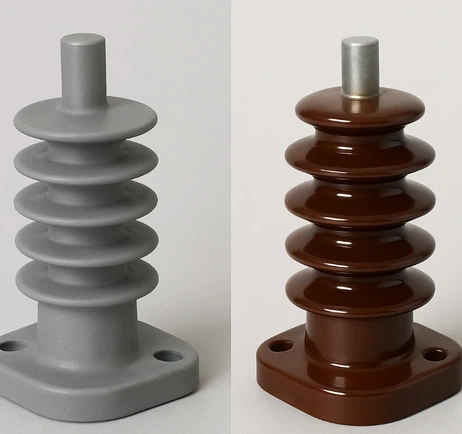
For a long time, most bushings were made of brown porcelain - that heavy, shiny ceramic material. It's incredibly tough against sunlight, rain, and electrical stress, and it lasted for decades. The downside? It's extremely heavy and can shatter like glass if hit hard by a falling branch or hail.
That's why many utilities are now switching to composite or polymer bushings. These grey, rubbery-looking insulators are much lighter, tougher, and far less likely to break. They make installation and maintenance a lot safer and easier for the crews.
What's Going on Inside the Bushing?
On the outside, it's fighting the weather. On the inside, things get even more interesting. If you cut one open, you'd find layers of special paper and foil wound tightly together - this is called capacitive graded construction. It helps gradually manage the high voltage so it doesn't punch straight through the insulation.
There are two main ways to protect these internal layers:
OIP (Oil Impregnated Paper): The traditional method using mineral oil. It works great but needs a perfectly sealed housing because any leak is bad news.
RIP (Resin Impregnated Paper): The newer solid epoxy version. It's more durable, doesn't leak, and is becoming the preferred choice for modern grids.
Why Bushings Sometimes Fail (The "Pressure Cooker" Problem)
Even with all this clever engineering, bushings don't last forever. Hot summer days cause everything inside to expand, putting serious pressure on the seals - kind of like a pressure cooker. Over time, tiny cracks can form, letting moisture sneak in. Once water gets into the insulation, it creates a hidden electrical path that can lead to sudden failure, sparks, or even a transformer fire.
That's why utility crews regularly check for signs of trouble: unusual buzzing, oil leaks, cracks, or excessive dirt. They also perform specialized tests like power factor testing and partial discharge monitoring to catch problems before they become dangerous.
Spotting Healthy Bushings in Your Neighborhood
So how can you tell if a bushing looks healthy from the ground? Here's a quick, informal checklist:
No visible cracks or chips
No dark oil stains running down the side
Not covered in thick dirt or grime
No strange buzzing or sparking sounds
Next time you're out for a walk, give these unsung heroes a quick glance from a safe distance. They're quietly doing a tough job - keeping massive amounts of electricity under control so the lights stay on and everyone stays safe.
Just remember: look, don't touch. These things are handling thousands of volts, and the smartest thing you can do is admire the engineering while keeping both feet firmly on the ground.


