Understanding the Costs of Solid State Transformers
Solid-state transformer cost depends on more than capacity: power electronics, voltage requirements, cooling, controls, and integration all influence the investment. Acquisition and integration costs remain higher than for conventional transformers, but added functionality can change the economics of the complete installation. This guide explains how to evaluate cost per kVA, compare alternatives, and build a defensible ownership-cost estimate.
How much does a solid-state transformer cost per kVA?
A meaningful solid state transformer cost per kVA requires a project-specific equipment scope and supplier quotation. Published research provides useful benchmarks, but material estimates, prototype budgets, and modeled capital costs are not interchangeable with commercial purchase prices. Treat any published figure as a study input until its assumptions match your application.
For example, a technical-economic study published in 2022 used these capital-cost assumptions:
| Transformer type | Study assumption |
|---|---|
| Conventional line-frequency transformer | $25/kVA |
| Hybrid transformer | $31.70/kVA |
| Solid-state transformer | $86.20/kVA |
These figures belong to that study's economic model; they are not current U.S. supplier quotes or general market averages. Their value is illustrating how one analysis compared the technologies under a defined set of assumptions-not establishing a procurement budget.
For your own comparison, calculate two separate metrics:
Equipment cost per kVA: Quoted equipment price divided by its specified continuous apparent-power rating.
Installed cost per kVA: The complete installed budget, including engineering, protection, commissioning, and required auxiliaries, divided by the same rating.
Label both clearly. Otherwise, an equipment-only offer can appear cheaper simply because installation work sits outside the quotation.
What you are paying for
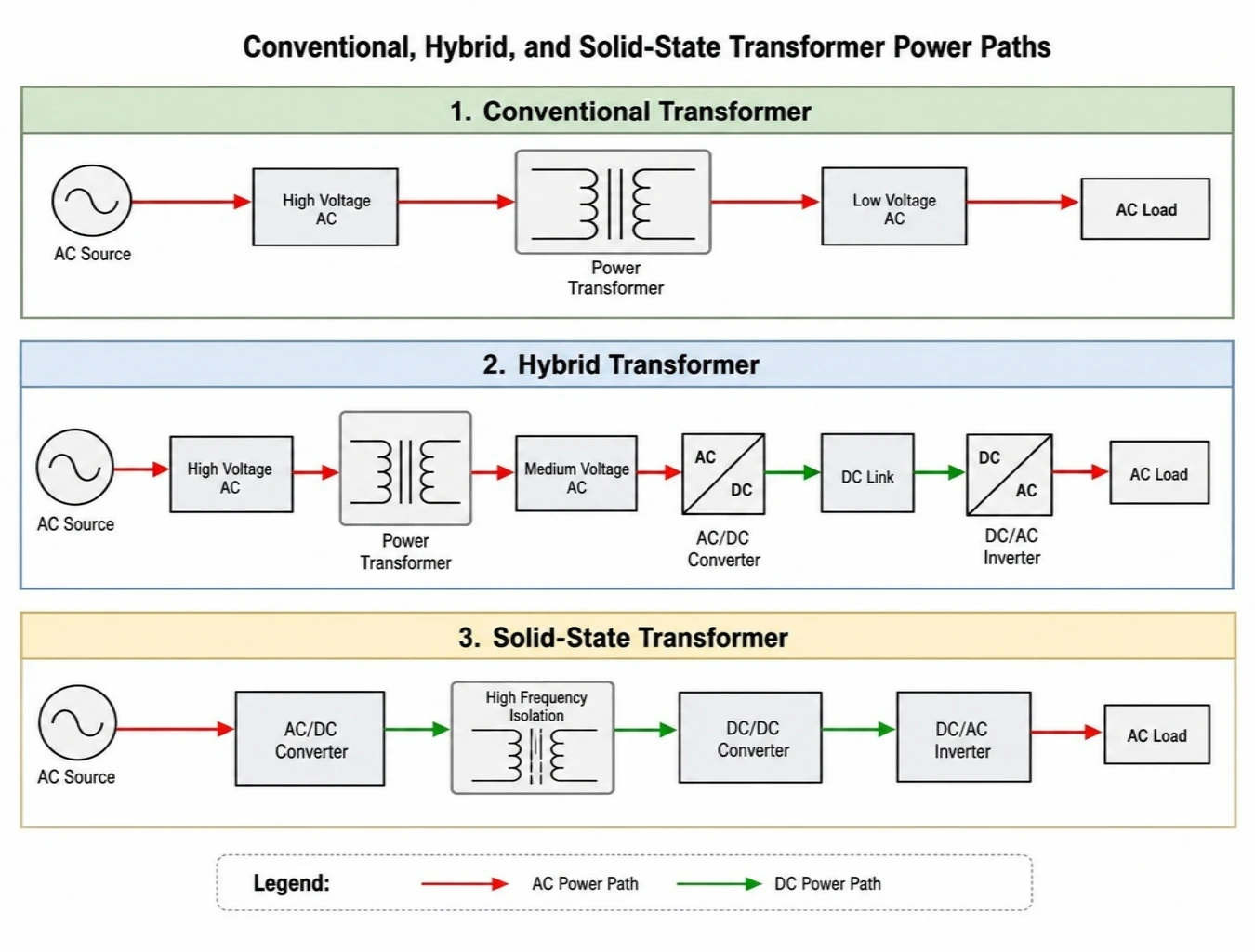
An SST combines power-electronic conversion with a smaller medium-frequency isolation transformer. Depending on its architecture, it can convert between AC voltage levels or provide DC interfaces, while adding electronic control over voltage and current. It does not eliminate magnetic isolation; it changes how that isolation and conversion are implemented.
Conversion hardware and thermal design
Semiconductors, high-frequency components, and advanced controls contribute to the upfront premium. Higher-voltage deployment also introduces additional engineering complexity, while insulation coordination and thermal management remain important design considerations. Consequently, matching kVA ratings alone does not establish that two offers cover equivalent requirements.
Ask vendors to identify the operating conditions behind their ratings. Request ambient-temperature limits, continuous output capability, cooling requirements, and any derating assumptions. Put these conditions alongside the price rather than leaving them buried in technical appendices.
Functionality and integration
The U.S. Department of Energy's 2023 advanced-transformer workshop identified potential SST benefits beyond voltage conversion, including distributed-energy-resource integration, reduced footprint, and controllable power flows. These capabilities create a reason to evaluate the installation as a system rather than price the transformer in isolation. They do not, by themselves, prove savings for a particular site.
Create a functionality schedule before requesting transformer pricing. Separate mandatory functions from optional ones, then ask suppliers to price the same scope. For example, specify whether DC output, reactive-power support, or bidirectional operation is actually required.
Solid-state transformer cost per kVA vs traditional transformer
The most useful comparison holds the electrical service constant. An SST serving a DC load should not be compared only with a conventional transformer if the conventional solution also needs rectification. Research comparing a 1 MVA SST with a conventional transformer found a substantially different outcome when the comparison included the downstream AC/DC conversion equipment.
That study found SST material costs at least five times higher for its direct AC/AC replacement case. However, its AC/DC comparison showed advantages in losses, weight, and volume for the SST-based solution. Those findings are specific to the analyzed designs, not a universal price multiplier or performance guarantee.
Use the following comparison boundaries:
| Budget category | What to include in both alternatives |
|---|---|
| Electrical conversion | Every stage needed to deliver the required final output |
| Protection and controls | Required switching, sensing, coordination, and communication |
| Site installation | Foundations, enclosures, access, cabling, and commissioning |
| Operating support | Cooling, maintenance provisions, spares, and service arrangements |
For a straightforward AC voltage-conversion project, test whether additional functionality has any financial value at all. For an integrated AC/DC project, identify exactly which separate devices each proposed architecture retains or removes. Compare those complete designs before drawing conclusions from the headline $/kVA.
Hybrid transformer vs solid-state transformer cost efficiency
A hybrid transformer combines a conventional low-frequency transformer with a fractionally rated electronic converter. The converter adds control capability without being rated for the full transformed power. ETH Zurich describes this approach as combining conventional transformer efficiency and cost characteristics with power-electronic flexibility.
This makes the hybrid option worth evaluating when the objective is better voltage or power-quality control rather than a fully redesigned conversion architecture. However, semiconductor protection remains essential: ETH identifies short circuits and switching or lightning transients as challenges for the electronic converter. Do not equate a smaller converter with negligible integration requirements.
Ask each bidder to define its controllable operating range. Specify the voltage correction, reactive-power support, and load conditions your project requires, then request evidence that the proposed converter rating supports them. Reject comparisons that price different levels of controllability as though they were equivalent.
How should efficiency affect the cost comparison?
Efficiency should be evaluated across the complete conversion path and actual operating profile, not from one component's peak figure. An SST may offer a better system result when it removes conversion stages, even if a conventional transformer alone has lower losses. Research on direct medium-voltage-to-DC conversion demonstrates why the system boundary matters.
For context, an ETH Zurich research demonstrator achieved 98.1% overall conversion efficiency in its specific data-center-oriented design. That result describes a particular device and operating arrangement, not every SST or every load point. Ask for measured performance relevant to your proposed installation.
For budgeting, request loss data at several representative operating points. Include auxiliary consumption and use the same input-to-output boundary for every option. Weight the results against your expected operating hours rather than assuming continuous full-load service.
A simple hypothetical example illustrates the arithmetic: if one complete system averages 2 kW less loss over 6,000 annual operating hours, it saves 12,000 kWh. At an assumed energy price of $0.12/kWh, that equals $1,440 annually. Neither the loss difference nor the tariff is a market estimate; substitute your project data.
Build a lifecycle cost model
Use this budgeting framework:
Lifecycle cost = installed investment + discounted energy, maintenance, repair, and replacement costs − discounted, demonstrable benefits.
Choose one analysis period and discount rate for all alternatives. Keep uncertain benefits separate from contracted savings, and avoid crediting the same improvement twice. For instance, do not count an avoided converter both as removed capital equipment and as a second, unrelated installation saving without checking the underlying estimate.
Build the model in five steps:
Define equivalent service. Fix input voltage, required outputs, continuous capacity, environmental conditions, and operating functions.
Normalize installed scope. Reconcile exclusions for civil works, protection studies, cooling, communications, testing, and commissioning.
Model operating expenditure. Apply the expected load profile and energy tariff; request supplier maintenance schedules and service pricing.
Test repair scenarios. Ask about spare modules, replacement procedures, support availability, warranty exclusions, and restoration assumptions.
Run sensitivity cases. Vary utilization, energy prices, repair expenditure, and uncertain benefits to see which assumptions change the decision.
Treat possible grid-service income or avoided infrastructure upgrades as conditional until the responsible parties confirm eligibility and technical feasibility. Request a conservative case without speculative revenue. A project that only works under optimistic assumptions deserves closer scrutiny before procurement.
Make the decision around verified value
Assessing solid-state transformer advantages, disadvantages, efficiency, and cost is ultimately an application-level exercise. Published research shows why direct AC replacement and integrated AC/DC conversion can lead to different conclusions; hybrid designs offer another route to added controllability. No single cost-per-kVA figure resolves all three choices.
Your final comparison should show equipment cost, installed cost, lifecycle cost, and the evidence supporting each claimed benefit. Favor the option that meets the required service with the strongest verified economics-not the lowest isolated price or the longest feature list. Keep unpriced risks visible, document assumptions, and update the model when binding quotations arrive.
FAQ
Q: How soon can you delivery the transformer?
A: It depends on the quantity and capacity of the transformer, normally within one month since the date drawing confirmed by buyer.
Q: How long can you provide the quality warranty?
A: 24 months since the date transformer operated.
Q: What payment method do you accept?
A: T/T (wire transfer) preferred, L/C both accepted.