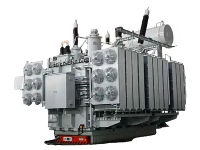
If those go wrong, nothing else really matters. The whole site just… stops.
Transformers: The Quiet Workhorse in the Background
 At the heart of every data center is a chain that starts from the utility grid and ends at a server rack. Somewhere in between sits the transformer, quietly doing heavy lifting.
A Power Transformer basically:
Steps down high-voltage grid power into usable levels
Keeps electrical isolation between grid and IT load
Helps stabilize voltage so sensitive equipment doesn't freak out
Supports clean, efficient distribution across UPS and PDUs
It's not flashy. You won't see dashboards celebrating it. But if it fails, you'll know immediately.
What "Maintenance" Really Means in a Data Center
People sometimes imagine data center maintenance as a checklist. In reality, it's more like a continuous loop-check, adjust, predict, repeat.
Here's how the main systems usually break down:
Core Maintenance Areas
| Area | What's Inside | What Teams Actually Focus On |
|---|---|---|
| Power system | Transformers, switchgear, busbars | Heat, load balance, insulation health |
| Backup power | UPS, batteries, generators | Runtime tests, failure readiness |
| Cooling | CRAC / HVAC systems | Airflow stability, temperature drift |
| IT systems | Servers, storage, network | Uptime, patching, hardware health |
| Monitoring | DCIM/BMS tools | Alerts, sensor accuracy, visibility |
Nothing works in isolation. One weak link and you feel it everywhere.
Transformer Maintenance: The Part You Can't Skip
Transformers tend to run 24/7 under load, often in warm environments. That alone makes maintenance non-negotiable.
Typical Maintenance Tasks
| Task | How Often | Why It Matters |
|---|---|---|
| Visual inspection | Monthly | Catch leaks, rust, or overheating early |
| Thermal imaging | Monthly or quarterly | Spot hot zones before failure happens |
| Oil testing (if applicable) | Quarterly | Check insulation quality and contamination |
| Insulation testing | Yearly | Make sure no hidden breakdown is forming |
| Connection tightening | Yearly | Prevent arcing and energy loss |
| Cooling checks | Monthly | Keep heat under control |

(Click the image to know more about transformer testing.)
It sounds routine, but skipping even one of these can snowball into real trouble.
The Problems That Usually Start Small (Then Get Expensive)
Most transformer issues don't appear suddenly. They creep in.
Common failure patterns:
Overheating that slowly gets worse over time
Insulation degradation that shows up late
Loose connections causing intermittent instability
Harmonic stress from modern IT loads
Cooling inefficiency that quietly accelerates aging
Nothing dramatic at first. Then one day-boom-unexpected downtime.
Preventive vs Predictive Maintenance (Big Shift Happening Now)
Traditional data center maintenance used to be mostly scheduled. Now it's shifting toward prediction.
| Approach | What It Means | Reality in the Field |
|---|---|---|
| Reactive | Fix after failure | Still happens, but risky |
| Preventive | Fixed schedule maintenance | Reliable but sometimes inefficient |
| Predictive | Sensor + analytics-driven | Becoming the new standard |
Predictive setups watch transformer temperature, load, vibration, and even harmonic distortion. The idea is simple: fix it before it becomes a problem.
Heat: The Silent Transformer Killer
If there's one thing transformers hate, it's heat. And data centers are basically heat factories.
Good maintenance usually includes:
Keeping airflow clear around transformer enclosures
Monitoring temperature continuously
Making sure cooling systems actually match load conditions
Preventing hotspots before they spread
Nothing fancy-just consistency.
Everything Connects to Everything
Transformers don't operate alone. They sit in the middle of a chain:
UPS systems depend on them
Switchgear distributes their output
Monitoring systems track their behavior
Cooling systems protect them from thermal stress
So when transformer maintenance slips, it's not just a "power issue." It can ripple into IT downtime pretty quickly.
What Good Operators Usually Do Differently
In stronger data centers, maintenance isn't reactive-it's structured and a bit obsessive (in a good way):
Build redundancy (N+1 or 2N design)
Run regular thermal scans
Track load trends over time
Use real-time monitoring instead of periodic checks
Plan maintenance windows around low traffic periods
Pay attention to harmonics, not just raw load
It's less about doing one big thing right, more about not missing small things repeatedly.
Final Thought
At the end of the day, data center maintenance isn't just about keeping systems running-it's about preventing surprises.
And transformers? They're not glamorous, but they quietly hold the entire power structure together. Ignore them long enough, and everything else becomes irrelevant very quickly.
Simple as that.
FAQ
Q: How soon can you delivery the transformer?
A: It depends on the quantity and capacity of the transformer, normally within one month since the date drawing confirmed by buyer.
Q: How long can you provide the quality warranty?
A: 24 months since the date transformer operated.
Q: What payment method do you accept?
A: T/T (wire transfer) preferred, L/C both accepted.