


In modern electrical systems-especially data centers and industrial facilities-harmonics are something you can't really ignore anymore. Between UPS systems, servers, VFDs, and all kinds of power electronics, the load is rarely "clean" like it used to be.
And honestly, that's where harmonic calculation comes in. It helps engineers figure out what's really happening in the system, not just what the nameplate says.
So, what are harmonics anyway?
In a perfect world, voltage and current would be nice smooth sine waves at 50Hz or 60Hz. Simple.
But real life? Not so clean.
Non-linear loads mess with that waveform and introduce extra frequencies-basically "noise" riding on top of the main signal. These are harmonics, and they show up as multiples of the base frequency:
3rd harmonic = 150Hz
5th harmonic = 250Hz
7th harmonic = 350Hz
Individually they might look small, but together they can really distort the system.
Why should you care?
Because harmonics aren't just a theoretical problem. They actually do things like:
Heat up transformers more than expected
Push neutral currents higher (sometimes a lot higher)
Increase cable losses
Mess with power factor
Trigger nuisance trips
And slowly, quietly reduce equipment life
In data centers, this becomes even more critical. Everything runs 24/7, and there's no "downtime window" where things can just cool off or reset.
THDi: measuring current distortion
One of the key metrics is THDi (Total Harmonic Distortion of current).
The formula looks like this:

Where:

A simple example
Let's say:
Fundamental current = 100A
5th harmonic = 20A
7th harmonic = 15A
11th harmonic = 8A
If you plug that in:

You end up with:
THDi ≈ 26.25%
That's actually quite a noticeable distortion level in many real systems.
THDv: voltage distortion
Voltage distortion (THDv) is calculated in the same spirit:

Example:
400V fundamental
12V 5th harmonic
8V 7th harmonic
Result:
THDv ≈ 3.6%
Voltage distortion is usually lower than current distortion, but it still matters-especially for sensitive loads.
RMS current: the hidden "extra load"
Here's something people sometimes overlook: harmonics increase actual RMS current.
The formula:

Using the same example:
100A fundamental
20A + 15A harmonics
You get:
IRMS ≈ 103.1A
So even though you "think" you're running at 100A, the system is actually carrying more. That extra few amps might not sound like much, but over time it turns into heat stress in transformers and cables.
K-Factor: what transformers actually care about
Not all harmonics are equal. Higher-order harmonics tend to create more heating, especially in transformer windings.
That's why we use K-Factor:
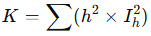
It basically weights harmonics by how damaging they are thermally.
In practice, K-rating looks like this:
| K-Factor | Where it's typically used |
| K-4 | Offices |
| K-13 | UPS systems |
| K-20 | Data centers |
| K-30 | AI workloads |
| K-40 | Extreme harmonic environments |
So yeah-this is not just theory. It directly affects transformer selection.

Where harmonics come from
Most of the time, the usual suspects are:
Traditional UPS systems (25%–35% THDi)
Server power supplies (20%–40%)
VFDs (can go as high as 80%)
LED drivers (15%–50%)
Modern electronic loads everywhere
Basically, if it has power electronics inside, it probably contributes.
Transformer sizing under harmonic stress
Here's where things get practical.
When harmonics are high, you can't just size a transformer based on kVA load alone. You often need derating.
Formula:

Example:
Load = 1000 kVA
Derating factor = 0.85
So:
Required size ≈ 1176 kVA → usually rounded up to 1250 kVA
That extra margin is what keeps things from overheating in real operation.
Quick selection guide
A rough rule of thumb engineers often use:
| THDi level | What you typically choose |
| <5% | Standard transformer |
| 5–15% | K-4 |
| 15–35% | K-13 |
| 35–50% | K-20 |
| >50% | K-30 / K-40 or harmonic mitigation solution |
In serious data centers or AI environments, it's not unusual to go straight to K-rated or harmonic mitigating transformers just to stay safe.

Final thought
Harmonic calculation isn't just some academic exercise-it's basically a way of seeing the "real stress" inside an electrical system.
Once you start looking at THDi, RMS current, and K-Factor together, you realize something important:
the nameplate load is not the full story.
And in modern data centers, that difference really matters.
FAQ
A: It depends on the quantity and capacity of the transformer, normally within one month since the date drawing confirmed by buyer.
A: 24 months since the date transformer operated.
A: T/T (wire transfer) preferred, L/C both accepted.


