

Delta-Wye Transformer (Δ–Y) Connection Explained: Phase Shift, Neutral, Grounding, and Uses
A delta-wye transformer (also written Δ–Y or delta–star) is a three-phase transformer connection where one side of the transformer windings is connected in delta (Δ) and the other side is connected in wye (Y). The most common arrangement in power distribution is delta primary, wye secondary because it provides a usable neutral on the low-voltage side and performs well with mixed three-phase and single-phase loads.

This article explains how the delta-wye connection works, its voltage/current relationships, the 30° phase shift, grounding implications, advantages/disadvantages, and common applications (including vector groups like Dyn11).
What Is a Delta-Wye (Δ–Y) Transformer?
A delta-wye transformer has:
Delta (Δ) winding: the three phase windings are connected end-to-end in a closed loop.
Wye (Y) winding: one end of each phase winding is tied together to form a neutral point, and the other ends become the line terminals.
You'll often see these in step-down distribution, such as:
Medium voltage (MV) delta → low voltage (LV) wye (3-phase, 4-wire)
Examples (region-dependent):
11 kV Δ → 400/230 V Y (neutral available)
13.8 kV Δ → 480/277 V Y (neutral available)
Delta (Δ) vs Wye (Y): Wiring Basics
Delta (Δ) winding basics
In a delta connection:
There is no neutral point.
The winding forms a closed loop, which allows certain circulating currents to flow internally (useful for harmonics and imbalance).
Line vs phase relationships (delta):

Where:
 = line-to-line voltage
 = voltage across one winding (phase)
 = line current
 = winding (phase) current
Wye (Y) winding basics
In a wye connection:
A neutral can be brought out and grounded.
It supports line-to-neutral loads (single-phase loads) as well as line-to-line loads.
Line vs phase relationships (wye):
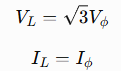
Voltage and Current Relationships in a Δ–Y Transformer
A transformer's turns ratio sets the relationship between the phase voltages of the two windings. But because delta and wye have different line/phase relationships, it's important to be clear whether you mean line-to-line or phase values.
A practical takeaway:
On the wye side, you get both:
Line-to-line voltage (3-phase loads)
Line-to-neutral voltage (single-phase loads)
For example, on a 400/230 V wye secondary:

This is one major reason utilities and facilities prefer Δ primary → Y secondary for distribution.
Phase Shift in Delta-Wye Transformers (Why It Happens)
A key characteristic of delta-wye transformers is that they introduce a 30° phase shift between the primary and secondary line-to-line voltages.
The delta and wye connections reference line voltages differently relative to their phase windings.
As a result, the secondary line voltages are displaced by +30° or −30° compared with the primary, depending on how the windings are connected.
Vector group notation (Dyn11, Dyn1)
Transformer nameplates often list a vector group, such as Dyn11.
D = Delta on the high-voltage (HV) side
y = Wye on the low-voltage (LV) side
n = Neutral brought out on the wye side
11 (clock notation) = phase displacement
Common ones:
Dyn11: LV typically lags HV by 30° (very common in distribution)
Dyn1: LV typically leads HV by 30°
Why phase shift matters
You generally cannot parallel transformers with different vector groups (or different phase displacement) without causing circulating currents and improper load sharing.
Phase shift also matters when interfacing with other supplies, metering, and protection schemes.
Neutral and Grounding: A Major Reason Δ–Y Is Used
Neutral availability on the wye side
A wye secondary provides a neutral point, enabling a 3-phase, 4-wire system. This is ideal when you have:
three-phase motors (line-to-line)
single-phase building loads (line-to-neutral), such as lighting and receptacles
Grounding benefits
When the wye neutral is grounded (solidly or through an impedance, depending on design):
the system has a stable reference to earth
ground faults can be detected more reliably
protective devices can operate properly based on expected fault current levels
(Exact fault behavior depends on the grounding method and the wider system configuration.)
Harmonics and Unbalance: What the Delta Winding Does
Triplen harmonics (3rd, 9th, 15th…)
Non-linear loads (VFDs, rectifiers, IT power supplies, LED drivers) can produce harmonics. In three-phase systems, triplen harmonics are "zero-sequence" components that tend to add in the neutral on wye systems.
A delta winding provides a closed path where some of these harmonic components can circulate within the delta, helping prevent them from propagating as strongly into the upstream system (the extent depends on design and loading).
Unbalanced loads
Delta-wye systems often perform well in real facilities because:
the wye secondary can serve unbalanced single-phase loads more naturally
the delta side can help absorb certain imbalance components (system-dependent)
Advantages of Delta-Wye Transformers
Neutral on the wye side
Enables 3-phase, 4-wire distribution and line-to-neutral loads.
Good for step-down distribution
Common for MV → LV supply in commercial/industrial installations.
Harmonic handling benefits
Delta can provide a path for triplen harmonic currents to circulate.
Grounding flexibility
Grounding the wye neutral provides a stable reference and can improve protection performance.
Isolation between systems
The transformer provides galvanic isolation; and the delta/wye arrangement can change how zero-sequence components transfer between sides (depends on grounding and configuration).
Disadvantages / Limitations of Δ–Y Transformers
30° phase shift complicates paralleling and system integration if vector groups don't match.
No neutral on the delta side (cannot serve line-to-neutral loads from delta).
Fault behavior depends heavily on grounding design; incorrect grounding choices can lead to protection issues or overvoltages during certain fault conditions.
In some scenarios, circulating currents in the delta can cause additional heating (especially with distortion/unbalance), which must be accounted for in design and loading.
Delta-Wye vs Wye-Delta (Δ–Y vs Y–Δ)
Delta-Wye (Δ–Y): typical reasons to choose it
Need a neutral on the secondary for mixed loads
Common LV distribution requirement (3-phase, 4-wire)
Often preferred for utility/service entrance step-down
Wye-Delta (Y–Δ): typical reasons to choose it
Used in some step-up or interconnection contexts
Delta secondary can be useful where no neutral is needed and certain harmonic/imbalance characteristics are desired
In both cases, remember: vector group and phase shift must match when paralleling or integrating with other transformers/sources.
Common Applications of Delta-Wye Transformers
Utility distribution transformers: MV delta primary to LV wye secondary (neutral grounded)
Commercial buildings: supplying 400/230 V or 208/120 V systems
Industrial plants: mixed three-phase motor loads and single-phase auxiliary loads
Facility step-down from MV to LV switchboards
Creating a grounded neutral reference for a local LV system (when designed for it)
FAQs: Delta-Wye Transformer Connection
What is the phase shift of a delta-wye transformer?
Typically 30 degrees (either +30° or −30°), depending on the vector group (e.g., Dyn11 vs Dyn1).
Does a delta-wye transformer provide a neutral?
Yes-on the wye side. If it's marked with "n" (e.g., Dyn11), the neutral is brought out for use and grounding.
Why is delta primary and wye secondary so common?
Because it provides a neutral for low-voltage loads, supports 3-phase and 1-phase loads, and offers practical grounding and harmonic benefits.
Can you parallel delta-wye transformers?
Yes, but only if key characteristics match-especially vector group, voltage ratio, impedance, and tap settings. Mismatched phase displacement can cause severe circulating currents.
Key Takeaways
A delta-wye (Δ–Y) transformer connects one side in delta and the other in wye (often Δ primary → Y secondary).
It introduces a 30° phase shift, indicated on the nameplate by vector group notation like Dyn11.
The wye side can provide a neutral, making it ideal for 3-phase, 4-wire distribution.
The delta winding can help manage triplen harmonics and certain imbalance components.
Always consider vector group compatibility and grounding design when specifying or paralleling Δ–Y transformers.
FAQ
Q: How soon can you delivery the transformer?
A: It depends on the quantity and capacity of the transformer, normally within one month since the date drawing confirmed by buyer.
Q: How long can you provide the quality warranty?
A: 24 months since the date transformer operated.
Q: What payment method do you accept?
A: T/T (wire transfer) preferred, L/C both accepted.


