

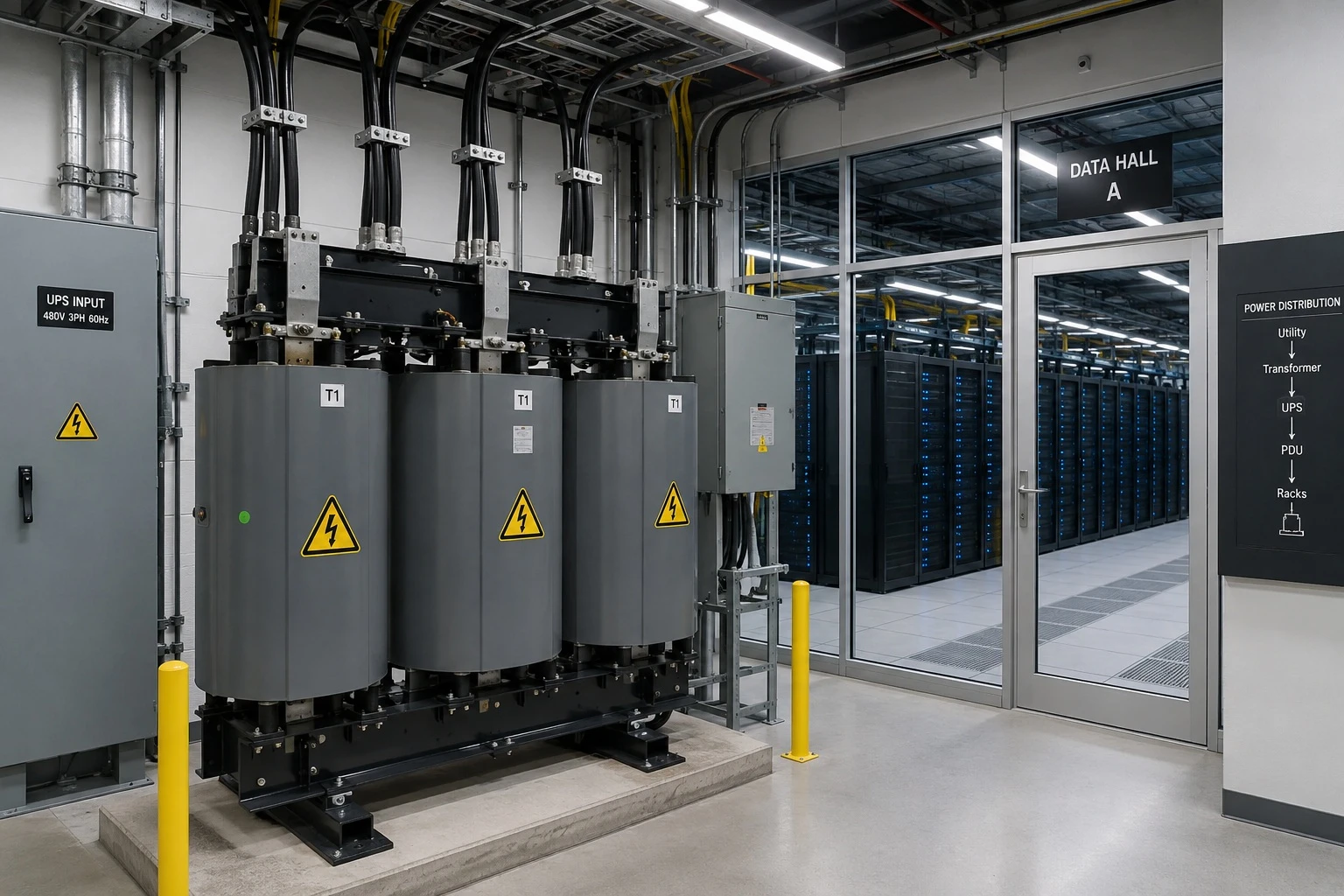
 Click here to know more about yaweitransformer
At first glance, sizing a transformer for a data center sounds pretty simple.
Just add up the loads, pick a transformer, done-right?
But in real life? Not usually.
A data center doesn't behave like a typical office building where demand rises and falls during the day. Servers and power systems keep running, cooling is basically on a schedule 24/7, and power demand can ramp up faster than you'd expect-especially with today's AI workloads and high-density setups.
So transformer sizing is less about what you need right now and more about what you'll need later. The future matters. A lot.
Start with the Actual Power Demand
Before you even look at transformer ratings, focus on what's actually consuming power inside the facility.
Most data centers tend to break power use into a few big buckets:
- IT equipment: servers, storage, networking gear
- Cooling systems
- Supporting equipment: UPS(data center Uninterruptible Power Supply) systems, lighting, monitoring, and other auxiliaries
The IT load is usually the easiest number to get because it directly matches the equipment on site. Cooling can be a bit messier. Depending on the design, cooling alone can be 30% to 50% of the total IT load-and in hotter climates, it may creep higher.
One common misstep (and it happens more than people admit) is sizing transformers based only on the current installed equipment. That might work for a while, but data centers rarely stay "as-is" for long.
Convert Load into Transformer Capacity
Here's the twist: transformers are rated in kVA, not
kW.

That means you have to factor in the power factor.
A basic starting calculation looks like this:
- kVA = kW ÷ Power Factor
Example:
- IT equipment: 1,200 kW at 0.95 PF
- Cooling: 800 kW at 0.85 PF
- Auxiliary loads: 200 kW at 0.90 PF
That comes out to about:
- 1,263 kVA for IT
- 941 kVA for cooling
- 222 kVA for auxiliary systems
Total? Roughly 2,426 kVA.
But very few projects stop at that neat, clean number. UPS losses, planned rack additions, unexpected load growth, and an operating reserve all push the final transformer size higher. In many cases, it ends up closer to 3,000–3,500 kVA.
Reliability Changes Everything
Honestly, redundancy can matter more than load math in transformer selection.
A smaller facility might use a simpler power architecture, but bigger data centers often need N+1 or 2N redundancy.
- N+1: one extra transformer available if another unit is taken out of service
- 2N: two fully independent power paths, each able to carry the full load
For Tier III and Tier IV sites, that kind of reliability isn't a "nice feature"-it's the whole point, because downtime just isn't acceptable.
Harmonics Are Easy to Overlook-Until They Aren't
Modern data centers are loaded with nonlinear equipment. Servers, UPS systems, and variable-speed drives all generate harmonics. Those harmonics don't just "exist"-they create extra heating in transformer windings.
And if you ignore that too long, you may see lower efficiency and reduced equipment life. Not great.
That's why K-rated transformers are common in data center environments. You'll often see K-13 or K-20 specified, but the real answer depends on the harmonic study and the load profile. (So, yeah-every project is slightly different.)
Dry-Type or Oil-Immersed?

For indoor installations, many operators lean toward cast resin dry-type transformers. The reasons are pretty practical:
- better fire safety
- minimal maintenance
- no oil leakage concerns
- easier installation inside buildings
Oil-immersed units still make sense in some outdoor applications and utility substations-especially when higher capacities are needed. There's no one-size-fits-all answer, unfortunately. It depends on the site and project requirements.
Leave Room for Growth
Here's another thing data center teams learn quickly: demand tends to grow faster than expected.
New servers show up. Rack density increases. AI workloads expand.
A transformer that feels comfortably oversized today might look undersized five years from now.
That's why many designers build spare capacity into the original plan. The extra investment upfront is often cheaper than replacing infrastructure later (which nobody wants to do).
Final Thoughts
There isn't a single perfect formula for transformer sizing that works for every data center.
Yes, load calculations are important. But you also have to account for redundancy, harmonic performance, cooling needs, efficiency goals, and long-term expansion plans.
As a general example: a facility with around 2 MW of IT load might end up using two transformers rated around 3,000–3,500 kVA each in an N+1 setup. The exact specs will vary by project, but the core principle stays the same:
Size the transformer not only for today's load, but for where the site is likely to be a few years down the road.
Contact now
FAQ
A: It depends on the quantity and capacity of the transformer, normally within one month since the date drawing confirmed by buyer.
A: 24 months since the date transformer operated.
A: T/T (wire transfer) preferred, L/C both accepted.


